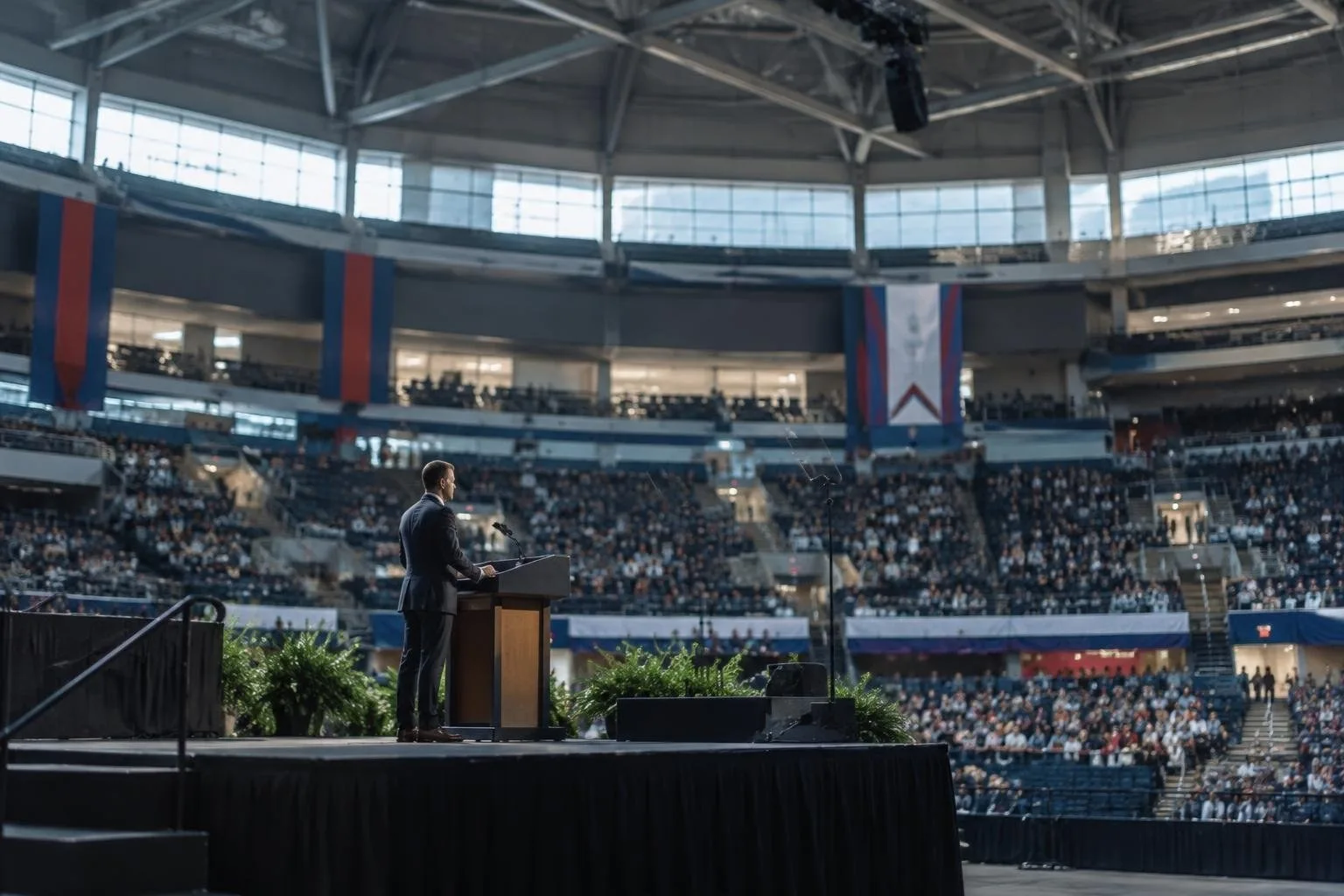
On November 1, 2026, former president Donald Trump descended on the Five Flags Civic Center in Dubuque, Iowa, just two days before the statewide midterm ballot. The event was billed as a final push to energize the GOP base ahead of contests for the U.S. Senate, the governor’s mansion, and three competitive congressional districts. Trump framed the upcoming vote as a decisive showdown that could reshape control of Congress and the state legislature.
Attendees heard a lineup of Republican candidates, each weaving personal narratives with the president’s signature themes of prosperity, national security, and cultural identity. Senate nominee Ashley Hinson, a former state representative, stressed her role as a “minivan-driving mom” and painted the race as a battle between “common sense” and what she called Democratic extremism. Governor hopeful Zach Lahn highlighted a proposed $15 billion steel mill in Lee County and invoked Christian values as the backbone of Western civilization. Congressional contenders Mariannette Miller-Meeks (1st District), Zach Nunn (3rd District), Joe Mitchell (2nd District) and Chris McGowan (4th District) each received brief mentions, underscoring the breadth of the Republican ticket.
Trump’s message: economic promises and political warnings
Trump’s two-hour speech leapt from local concerns to national policy. He warned that any Democratic win would usher in a “deranged group of extremists” threatening the economy, gas prices and the ongoing war in Iran. The former president cited an $8 billion farmer fuel assistance program and the steel-mill proposal as concrete examples of GOP stewardship delivering jobs and lower costs. He also touted a $15 billion tax credit package that could create roughly 1,750 permanent positions in southeast Iowa.
Interwoven with policy points were personal comments that attracted media attention. While praising Hinson’s dedication, Trump remarked on her past weight, claiming she had “got into shape the old-fashioned way” for voters. The comment provoked a brief interruption, after which Trump dismissed the protesters as “paid plants” and continued urging a “turnout election” that would keep the Senate under Republican control.
Supporters, dissenters, and protestors on the ground
Beyond the stage, the rally revealed a mosaic of reactions. Long-time Republicans such as Rep. Mariannette Miller-Meeks and Rep. Zach Nunn broke with some party factions by endorsing limits on Trump’s war powers, echoing concerns over the Iran conflict. Both took the stage in Dubuque despite abstaining from a prior Sioux City appearance, signaling a nuanced stance that blended loyalty with calls for congressional oversight.
Grassroots attendees expressed confidence that Trump’s policies had already improved their businesses. Bettendorf activist Cynthia Diercks linked lower taxes to the president’s agenda, while De Witt resident Keith Stein praised efforts to revitalize manufacturing and curb government waste. In contrast, downtown Dubuque saw a small but vocal group of demonstrators holding signs—one depicted Trump as a pig, another shouted “Down with the swing king.” Protesters accused the rally of deepening Iowa’s urban-rural divide, yet many acknowledged shared concerns such as healthcare affordability.
Local Democrats, gathered earlier in Cleveland Park, framed the presidential visit as evidence that Republican candidates were scrambling for relevance. Former state Senate President Pam Jochum suggested that Hinson’s campaign struggled to connect with voters independent of Trump’s endorsement.
The evening concluded with Trump urging voters to treat the November ballot as a referendum on “common sense versus crazy,” echoing House Speaker Mike Johnson’s call to dismiss unfavorable polls. As supporters filed out through barricaded streets, the message was clear: Republican leaders counted on a roughly 180,000-voter registration edge to offset concerns over rising living costs, gasoline prices, and foreign policy entanglements.