
Argomenti trattati
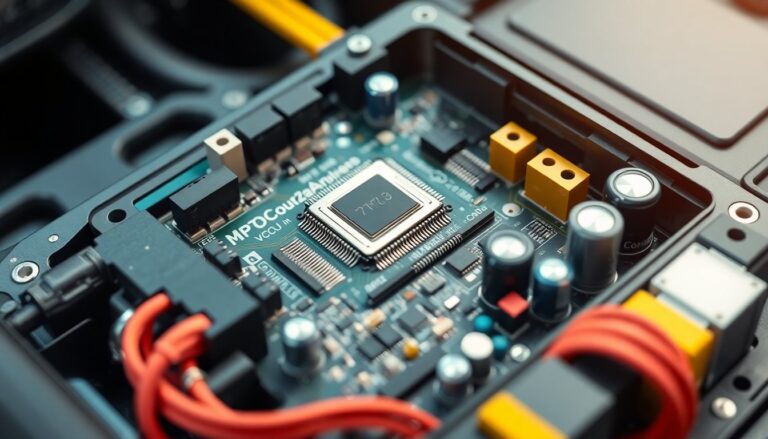
STMicroelectronics announced the Stellar P3E on Feb 10, 2026. The company described it as an automotive microcontroller that pairs high-performance real-time control with dedicated on-chip AI acceleration. The device targets the shift toward software-defined vehicles. It aims to simplify multi-function integration for X-in-1 electronic control units (ECUs) and to reduce system cost, weight and architectural complexity.
The palate never lies. Behind every dish there’s a story, and in automotive electronics that story is integration and efficiency. As a chef I learned that combining complementary elements yields greater results. STMicroelectronics applies the same logic to vehicle electronics.
What makes the Stellar P3E different
The company positions the Stellar P3E as a novel fusion of classic MCU cores and an automotive-grade neural processing unit. That on-chip NPU enables local inference and always-on AI capabilities without routing workloads to centralized compute hubs. The design aims to keep latency low and preserve bandwidth for critical vehicle functions.
The device is intended to support functions such as predictive maintenance, virtual sensors and faster EV charging strategies. STMicroelectronics says the controller will operate within stringent automotive safety constraints and fit typical vehicle power and thermal budgets. The architecture targets fewer discrete controllers by consolidating functions into a single, certified component.
Behind every dish there’s a story of provenance and technique. Similarly, the Stellar P3E reflects industry demand for closer integration of sensing, control and machine learning at the edge. The move could alter ECU architectures and supplier chains by enabling more distributed intelligence across the vehicle.
Edge intelligence tuned for the road
The move could alter ECU architectures and supplier chains by enabling more distributed intelligence across the vehicle. The palate never lies: in an engine, sensing and timing determine performance as surely as seasoning shapes a dish. This device pairs razor-fast, low-power AI inference with real-time control to meet those demands.
On-chip neural processing for continuous functions
The product integrates the ST Neural-ART Accelerator™, an on-chip NPU designed for real-time, low-power inference. Its data-flow architecture delivers inference at microsecond latencies and offers up to 30x greater efficiency versus equivalent models on standard MCU cores. That efficiency enables continuous AI tasks at the vehicle edge, from sensor fusion to predictive diagnostics.
Real-time control and mixed-criticality flexibility
Complementing the NPU, the MCU includes dual Arm® Cortex®-R52+ cores running at 500 MHz. The package achieves a class-leading CoreMark score above 8,000, reflecting strong raw control performance. A split-lock architecture lets engineers tune the balance between functional safety and peak throughput, a practical feature for mixed-criticality domains such as powertrain, body electronics and zonal compute.
Behind every hardware choice there’s a use case: continuous, low-power AI for driver assistance and local fault prediction, combined with deterministic control for actuation. As a chef I learned that timing and balance matter; in automotive systems the same principles guide partitioning between safety-critical control and opportunistic AI workloads.
Real-time control and safety
The Stellar P3E combines deterministic control with an embedded neural processing unit to support sub-millisecond decision loops needed for advanced vehicle control. The design integrates analog interfaces and rich I/O to manage complex motor control and actuation while meeting stringent automotive safety requirements. As a chef I learned that timing and balance matter; the same principle guides partitioning between safety-critical control and opportunistic AI workloads in vehicles. The approach reduces reliance on costly, thermally constrained system-on-chip solutions for latency-sensitive functions, allowing engineers to keep critical loops local and predictable.
Scalability through extensible memory and ecosystem support
To meet the evolving software demands of SDVs, the Stellar P3E incorporates xMemory, ST’s proprietary phase-change memory (PCM) technology. The xMemory offers roughly twice the density of comparable embedded flash and is qualified for automotive environments, enabling OEMs to expand storage without a hardware redesign. Behind every dish there’s a story, and behind every update there is a supply chain: this memory choice supports over-the-air feature rollout and long-term software evolution while keeping the hardware footprint compact.
The palate never lies: precision matters in engineering as in cooking, and ST supports that precision with a complete software and deployment toolchain. The MCU belongs to the ST Edge AI Suite, which spans dataset preparation through on-device deployment. The NanoEdge AI Studio tool now covers the whole Stellar family. Stellar Studio, ST’s development environment for automotive engineers, incorporates Stellar P3E to support rapid prototyping, model optimization and field updates. This integration ensures a continuous path from data to deployed feature while keeping the hardware footprint compact.
Benefits for vehicle architects and OEMs
Moving AI inference to the edge reduces wiring, sensor duplication and integration overhead by enabling virtual sensors that infer state from existing signals. OEMs can add new behaviors and improve EV charging strategies without fitting larger SoCs. Local neural processing units lower latency in sensing-to-actuation pathways, which is critical for responsive vehicle subsystems. As a chef I learned that efficient use of raw materials transforms a dish; in the same way, on-device AI leverages existing signals to deliver new features with lower cost and thermal impact.
Technical highlights and production timeline
The palate never lies: precision in ingredient choice mirrors precision in silicon design.
STMicroelectronics bills the Stellar P3E as a unified platform for deterministic control, on-device inference and scalable memory in one package. Key elements include a high-frequency core pairing, an on-chip neural accelerator and a configurable safety/performance fabric. Designers will find rich analog and I/O resources aimed at advanced motor and body control tasks.
STMicroelectronics has announced a start of production date in Q4 2026. The company frames the timing as aligned with incoming automotive program cycles and tier-one qualification windows.
Implications for the automotive industry
Behind every dish there’s a story; the same applies to vehicle systems where supply chains, software and hardware converge.
The Stellar P3E targets applications that require real-time determinism alongside edge AI. That combination may reduce reliance on centralized domain controllers for some functions. Automakers could map features such as predictive motor torque control, adaptive climate-actuation strategies and local sensor fusion onto the device.
As a chef I learned that efficient use of raw material lowers waste. Similarly, on-chip inference can cut wiring, weight and thermal load in vehicle subsystems. Those efficiencies matter for electric vehicles where every watt affects range.
For safety-critical domains, the MCU’s configurable architecture offers design teams a path to balance performance and redundancy. That could shorten development cycles for advanced driver assistance subsystems and certain body-control functions.
Supply timing remains a practical risk. Q4 2026 production start means second-source planning and early prototyping are prudent steps for OEMs and suppliers. Early engagement with software tools and validation suites will determine how quickly teams can translate silicon capability into road-ready features.
Expected near-term outcomes include denser feature integration at lower system cost and faster iterations of control algorithms. Continued alignment between semiconductor roadmaps and automotive program milestones will shape adoption rates.
Embedding AI into microcontrollers shifts compute to the edge
Embedding artificial intelligence acceleration directly into an MCU shifts where automotive compute is performed. Instead of centralising neural workloads in domain controllers, processing can occur at the sensor or actuator where data originates. This approach reduces latency, lowers energy use and simplifies system architecture.
The architecture supports faster reaction times for safety and driver-assist functions. It also eases thermal and power budgets in electrified platforms. These benefits grow in importance as vehicles adopt more software-defined functions and complex sensor suites.
The Stellar P3E is positioned as a single, extensible component that reconciles deterministic control with advanced sensing and on-going software evolution. Backed by ST’s software ecosystem, the module aims to shorten development cycles and enable staged feature rollouts without wholesale hardware replacement.
The palate never lies: deploying compute where signals are freshest preserves fidelity and response. As a former chef I learned that choosing the right ingredient at the right moment determines the final result; in automotive design, localised processing does the same for system performance.
Technically, integrating AI cores into MCUs demands careful partitioning of workloads, predictable real-time behaviour and secure software update paths. Deterministic control must coexist with opportunistic neural inference. Manufacturers will need validated toolchains and safety analysis to certify mixed workloads in production vehicles.
Supply-chain and program-timing alignment will influence adoption. Continued coordination between semiconductor roadmaps and automotive program milestones will determine how quickly manufacturers integrate local AI into production vehicles.
Behind every design choice there’s a story of trade-offs: reduced system complexity, potential cost shifts and new verification burdens. The next phase will test whether localised AI at the MCU level can deliver measurable gains across power, latency and feature agility in real-world driving conditions.