
Argomenti trattati
The Brazil round of the MotoGP championship delivered a rollercoaster of sensations: an almost Jerez-level crowd, passionate support from across South America and then an ugly technical problem that rewrote the race plan. Minutes before the field left for the warm-up lap, officials announced the top-class race would be shortened from 31 laps to 23 laps — the decision based on the fact that 23 laps represent 75% of the planned distance, the threshold to award full points and classify the event as a complete race.
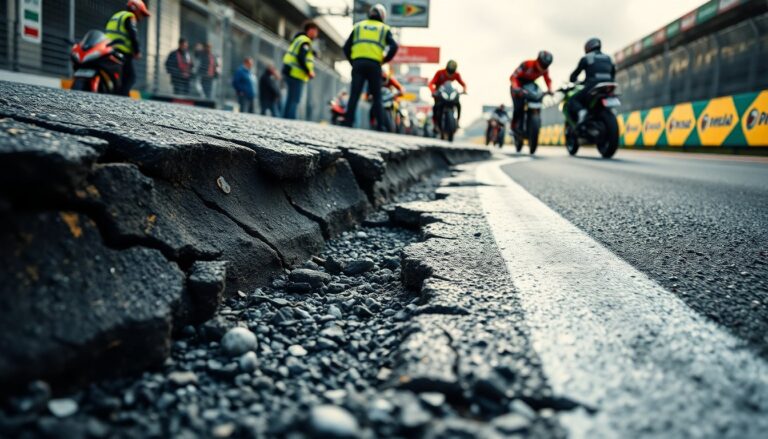
The atmosphere in the grandstands contrasted sharply with the paddock’s frustration. What should have been a tactical exercise about tyre choice and fuel strategy became a scramble as teams tried to adapt to a track that was visibly shedding material in high-speed sections. The affected area — notably around Turn 10 and Turn 12 — was reported to be losing stones and showing signs of the surface coming apart, creating safety issues and the need for urgent judgment calls.
What happened to the track
Technical eyes immediately turned to the construction and recent works on the circuit. Expert commentary pointed to the specialised nature of laying a race-quality surface: the correct proportion of tar and aggregate and the right paving temperature are essential to lock the stones into the asphalt matrix. When those parameters are off, the result can be loose chips and early disintegration. Observers also noted visible dirt across the racing line and the presence of fresh rubber from the support categories, which changed feedback for riders and hid developing defects until they worsened under load.
Why the surface failed
From the images and reports, the symptoms were clear: fragments of pavement were being expelled when bikes ran over the affected curves, effectively turning the line into a shower of pebbles. Riders described the sensation in different ways — from motocross-like grab to a feeling akin to riding on sand — but the common concern was flying debris and the unpredictable grip. With stones embedded in tires and bouncing up toward competitors, the practical outcome was a safety issue significant enough to justify altering the race format rather than risking further track damage across the full distance.
Race-day fallout and strategy implications
The late announcement created the biggest operational headache. Teams would normally adapt fuel load, traction control maps and engine braking choices once the expected race length is confirmed; a shorter race often means less fuel and more aggressive tyre selections. With only minutes to react, most crews had no realistic chance to make comprehensive changes. The rarely used hard tire was not selected by anyone in the top class, and the contest became a bet on the soft tire for many. Had they been given more lead time, squads would have recalibrated fuel load and electronic settings to suit the new plan — changes that can materially alter race pace and overtaking opportunities.
Communications and regulation
Teams argued about the timing of the information and whether a brief delay before the start might have allowed a fairer window for choices. The rules allow a delayed start if there is a problem that could prejudice safety at the beginning of the race; tyre preference alone does not normally meet that threshold. Race management opted to run the event while reducing distance to limit deterioration. That preserved championship points and prevented the worst-case scenario of a heavily damaged surface after a full-length race, but it left several riders and crew feeling short-changed by the abrupt notice.
Voices from the paddock and what comes next
Reactions in the paddock were mixed but often heated. One rider compared the feel through the damaged section to sand, citing a lack of consistent grip and unexpected loose stones. Others reported that the warm-up lap revealed unusual surface colour and texture, as if debris or a service vehicle had crossed the racing line. A prominent competitor expressed anger that his team received the decision too late to swap tyres; another said he would have chosen the soft regardless and suggested at least a ten-minute heads-up would be reasonable in future.
Looking forward, circuit owners will likely face repairs ranging from targeted patching to a broader resurfacing, depending on a technical inspection. The incident highlights how the fine margins of paving technique and race scheduling collide with the high-stakes nature of modern MotoGP. This piece is part of a continuing series of behind-the-scenes analysis and interviews available to supporters of our site. If you value deeper paddock insight and technical breakdowns, consider subscribing or supporting our Patreon for full access to exclusive content.