
Argomenti trattati
Daytona 500 disrupted by multi-car crash on lap 124
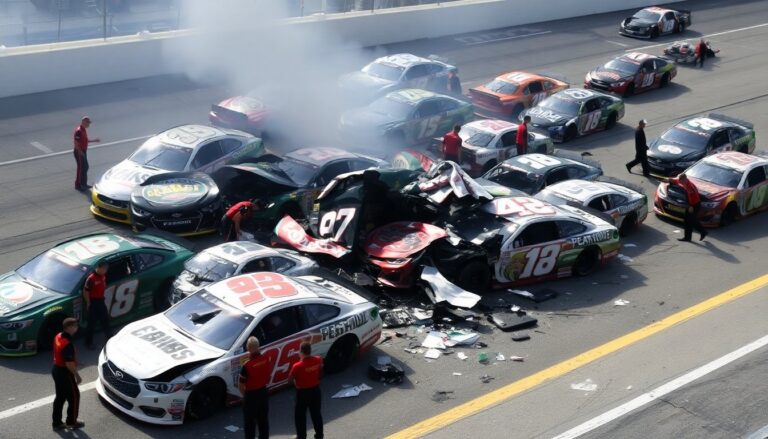
A chain-reaction collision on Lap 124 interrupted the 68th running of the Daytona 500, collecting nearly two dozen cars and reshuffling the race order. The incident occurred during a routine battle for position and forced teams to alter strategy mid-race.
Drivers, pit crews and officials responded as safety crews cleared debris and removed damaged machines. The crash had immediate competitive consequences, with contenders dropping out and others moving into contention after pit stops and repairs.
The event was reported in connection with a story published on 15/02/21:41. Replay footage shows the incident unfolded in quick succession, turning a single moment into one of the weekend’s most consequential developments.
Anyone who has raced knows that a single error can cascade. Teams now face reset decisions over fuel, tyre choices and whether to pursue aggressive repairs. Analysts and fans can expect the lap to dominate highlights and tactical post-race analysis.
Analysts and fans will replay the sequence repeatedly in post-race breakdowns. The contact unfolded in the final turn as the field jostled for position. Justin Allgaier had just taken the lead exiting Turn 4 in a car owned by Dale Earnhardt Jr. and Kelley Earnhardt Miller. His move to the front forced rivals to respond instantly.
How the contact happened
Allgaier’s exit opened a lane on the outside. Three-time Daytona 500 winner Denny Hamlin dove to that outside lane in an aggressive bid for the lead. The two drivers ran side by side for a short stretch. A slight steering input by one or a defensive line by the other led to a lane change that reduced available space.
The result was a brush of bodywork that unsettled one car’s balance. That instability propagated through tightly packed cars behind them. Brake bias and aerodynamic wake compounded the effect, turning a single touch into a multi-car sequence.
Anyone who has launched a product knows that small, unexpected changes cascade quickly; the same principle applied on the track. I’ve seen too many startups fail to plan for edge cases, and on race day those edge cases are the single moments that decide outcomes.
Teams will now study telemetry and onboard footage to determine precise steering and throttle inputs. Spotters’ radio traffic and split-second decisions in the draft will be central to official reviews. Expect teams to focus on lane discipline, push-ride tendencies and how drivers protect running room in the closing corner.
Race officials and crew chiefs will use those data points in appeals or strategy adjustments. The lap will influence tactical planning for upcoming superspeedway events and how teams value clean draft partners. The final technical review will clarify responsibility and any potential penalties.
The aftermath and scale of the wreck
The crash produced a rapid, multi-car pileup that swept through the pack immediately behind the leaders. On-board footage shows cars braking and weaving in fractions of a second. That created an accordion effect that left vehicles damaged in several lanes.
Race control deployed safety teams and cautions while marshals attended to crews on track. There were no official statements about serious injuries at the time this account was prepared. Team radio and pit reports confirmed widespread damage and multiple retirements.
Television replays and timing data will form the basis of the technical review. Stewards will examine steering inputs, throttle application and line choice to determine fault. The final technical review will clarify responsibility and any potential penalties.
I’ve seen too many race moments snowball after a single misjudgment. Anyone who has launched a product—or a run at the finish—knows that small errors cascade. Growth data tells a different story: at superspeedways, margins are microscopic and consequences are immediate.
Teams now face repair bills and setup resets ahead of the next event. The incident will feature in post-race analysis sessions and will shape strategy conversations about pack racing and lane discipline.
Implications for competitors
The incident followed the previous note that it will feature in post-race analysis and shape debates on pack racing and lane discipline. The pileup involved roughly 20 cars, leaving several teams with terminal damage. Crews moved quickly to assess chassis integrity, suspension and aero parts. Many cars were retired or repaired but no longer competitive.
The caution changed the race calculus. Crew chiefs had to redraw plans for pit strategy, tyre allocation and fuel windows. Teams that pitted under the red flag preserved track position at the cost of older tyres. Others gambled on fresher rubber and shorter stints to chase clean air.
Anyone who has managed a race knows that tyre life and fuel math decide the closing laps. The caution tightened the field and compressed intervals. That increased the value of track position and made single-lap speed less decisive.
From a championship perspective, the incident cost several contenders crucial points. Spotters and crew chiefs will review radio calls and positioning in the pack. Race control may also face scrutiny over how the restart and subsequent gaps were managed.
Technical teams will focus on data from impact sensors and telemetry to determine damage extent. Repairs that address steering and suspension take priority. Teams with damaged aero will struggle to match pace even after pit work.
I’ve seen too many races swing on a single lap to overrate the surviving advantage. Growth data tells a different story: consistency over a season outweighs one dramatic recovery. For teams still running, the task is clear—minimise further risk, optimise stint planning and target clean laps to recover lost ground.
For teams still running, the task is clear—minimise further risk, optimise stint planning and target clean laps to recover lost ground. Caution laps compress the field and create immediate opportunities to gain track position. They also erase previously built advantages and force crews to rethink strategy on the fly.
How teams adapt during a restart
Some crews went straight into repair mode after heavy contact. Others chose to preserve cars and tyres for the final runs. Pit decisions split the race into two distinct tactical paths: short-term aggression to reclaim spots or conservative consolidation to reach the finish with a serviceable machine.
The episode underlines how one high-speed moment in the draft can reshape championship narratives. Drivers who avoided major damage found themselves unexpectedly in contention for big points. Those sidelined faced early retirements or extended repair windows that effectively ended their chances.
I’ve seen too many startups fail to pivot after a shock to their model; the analogy applies on track. Teams that adapt quickly to the new race geometry and updated stint plans stand the best chance of turning the interruption into advantage. Growth data tells a different story: small timing advantages at the pit box or a successful two-lap push can yield outsized position gains in the closing stages.
The Daytona 500 remains a marquee event where a single incident carries outsized consequences for both race results and season momentum. Anyone who has raced at this level knows that recovery is possible, but it demands disciplined execution from drivers and crews.
Anyone who has raced at this level knows that recovery is possible, but it demands disciplined execution from drivers and crews. The incident on Lap 124 at the superspeedway underscores how narrow the margin for error becomes when pack racing dominates.
Drivers fighting for the lead converted tiny positioning choices into decisive consequences. Side-by-side runs amplify the aerodynamic effects, and the resulting turbulence can unsettle cars in an instant. Pack dynamics mean one driver’s movement propagates through the group. On Lap 124 that chain reaction produced contact involving multiple cars.
Teams will now dissect telemetry and video footage to isolate the sequence of events. Engineers will map steering inputs, throttle traces and wake patterns. Spotters and crew chiefs will review the calls that preceded the contact.
I’ve seen too many races decided by a single, marginal error. Growth data tells a different story: in motorsport, small mistakes scale fast. Anyone who has launched a product—or a race strategy—knows that unforced errors compound under pressure.
What comes next
Race control must determine penalties and restart procedures. Teams still running will reassess stint lengths and tyre windows to regain track position. Drivers involved will be evaluated for injuries and fit to continue.
Preventing similar pileups hinges on clearer communication, calibrated risk-taking and, where possible, changes to formation strategies. Engineers can tune aero balance to reduce susceptibility to turbulent air. Crew chiefs can adjust coaching to discourage marginal moves when the field is tightly packed.
The immediate focus is pragmatic: repair serviceable cars quickly and protect the championship outlook. Long term, the sport will study whether procedural or technical changes can reduce the likelihood that one small action triggers a multi-car incident.
Analysis and implications for safety and competition
Long term, the sport will study whether procedural or technical changes can reduce the likelihood that one small action triggers a multi-car incident. Race officials, teams and broadcasters will review telemetry, in-car footage and steward reports to identify preventable links in the chain of events.
Safety engineers will assess whether adjustments to pack racing protocols, restraint systems or barrier technology could lower risk without altering the sport’s character. Independent experts and manufacturers will be asked to test proposed fixes under controlled conditions.
For spectators, the replayed footage and post-race interviews will clarify how the sequence developed. Broadcasters will use slowed angles and data overlays to show contact points and timing. That coverage will shape public perception and inform debate about any rule changes.
The competitive picture has shifted. Several contenders were eliminated, while others gained renewed opportunities to score points and prize money. Teams now face compressed repair windows and altered strategies for the remainder of the event.
I’ve seen too many races decided by small mistakes to assume quick fixes will solve systemic risk. Real improvement requires measurable changes, rigorous testing and willingness from stakeholders to accept trade-offs. Growth data tells a different story: safety gains often come at operational cost, but they preserve the sport’s long-term sustainability.
Anyone who has launched a product knows that iterative change beats one-off solutions. Expect phased recommendations, pilot trials and a focus on metrics such as incident frequency, severity and repair time. The coming weeks will reveal whether the sport adopts marginal tweaks or deeper reforms.
Key areas under review include communication protocols, car-to-car interaction limits and post-incident response times. Teams and officials will publish technical findings as they become available, allowing independent scrutiny and industry-wide learning.