
Argomenti trattati
The 2026 MotoGP weekend in Brazil marked a notable — and unexpected — chapter for the championship as riders and teams arrived at the Autodromo Internacional de Goiania. First impressions of the circuit were vivid: a compact layout, unpredictable grip after the rainfall, and one particularly memorable problem when a sinkhole opened on the main straight. Organisers moved fast to diagnose and mend the issue while race control balanced safety and the broadcast schedule. The atmosphere combined excitement and frustration as fans watched crews work to restore the surface and teams recalibrated their plans for the sessions to come. Throughout, commentators and paddock voices kept returning to how a single surface failure can change an entire race weekend.
On the sporting side, the weekend offered contrasting storylines. Aprilia continued to present a competitive package, whereas KTM and Honda were clearly on the back foot trying to arrest early-season issues. The on-track drama included a tussle involving Marc Marquez and Fabio Di Giannantonio that ultimately saw both riders overtaken by Jorge Martin, raising questions about whether Marquez’s mistake was ordinary, a lingering effect of past injuries, or something influenced by the track surface. Meanwhile, Marco Bezzecchi secured his second consecutive victory, further shaping championship narratives and giving teams plenty to dissect after the chequered flag.
Track problem and how officials responded
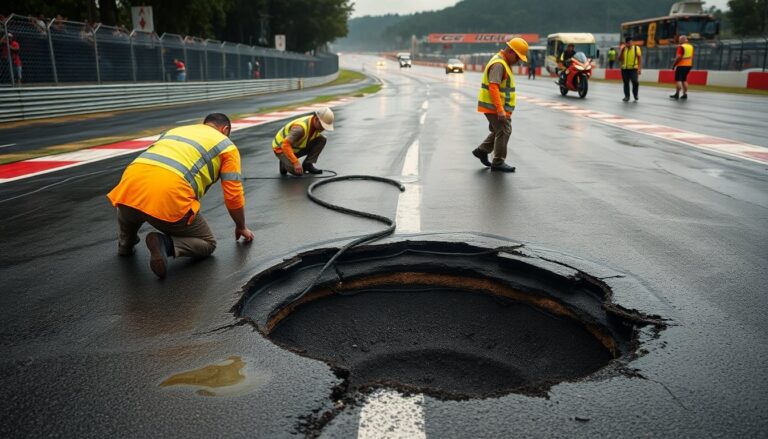
Heavy rain in the Goiás region left parts of the circuit vulnerable, and at one point a localized track surface depression developed on the main straight. Photos from the scene showed workers excavating a strip approximately one meter wide and 2.5 meters long, oriented at right angles to the racing line, before filling the void with gravel and preparing to relay asphalt. The FIM and the local promoter coordinated repairs while MotoGP organisers provided periodic updates. Tome Alfonso, the FIM MotoGP Safety Officer, explained that the problem resulted from soil movement after prolonged rainfall and stressed that the defect was away from the racing line. The priority throughout was ensuring the circuit met safety benchmarks before high-speed activity resumed.
Cause, temporary fixes and remaining concerns
From available imagery and the statements released, the opening in the surface appeared to be due to washed-away soil beneath the tarmac rather than the kind of dissolution seen in limestone karst regions. That distinction matters because it suggests the immediate repairs — digging out the affected area, backfilling with aggregate and overlaying fresh asphalt — are likely to be effective in the short term. Still, teams and officials voiced understandable caution about whether other circuit sections might have suffered similar hidden erosion. The episode serves as a reminder that heavy rain can create sub-surface instability and that a quick fix does not erase the need for systematic inspection across the entire venue.
Racing fallout and key on-track moments
Beyond the logistics, the incident had direct sporting consequences. The scrap between Marquez and Di Giannantonio that ended with them both being passed by Jorge Martin became one of the weekend’s focal points. Marquez publicly pointed to the surface as a factor in his mistake, prompting debate over whether this was a routine error, a vestige of prior injury, or simply part of a rider’s evolving form. At the front, Marco Bezzecchi converting another strong result into a second straight win underlined his momentum and shuffled the competitive pecking order. Several teams noted that wet patches and track repairs required different setup choices and tyre strategies, amplifying the challenge for squads already wrestling with consistency.
Schedule adjustments and practical implications
To accommodate the repairs the organisers issued a revised timetable: the motogp tissot Sprint was delayed by about twenty minutes, and qualifying for the Moto2 and Moto3 classes was rescheduled to follow the sprint. MSEG’s communications made clear that the revised plan aimed to preserve on-track action while guaranteeing safety checks were completed. For teams, a truncated warm-up window and shifted sessions meant engineers and riders had to adapt quickly, recalibrating tyre choices, fuel loads and practice runs. For fans and broadcasters, the change compressed the day but ensured the core spectacle remained intact.
Takeaways for the season and the fans
Goiania’s return to the MotoGP calendar will be remembered for more than the podiums: the circuit’s short, intense laps and the drama of a track repair created a weekend full of stories. Some pundits joked about the contrast between large commercial investments and the unpredictable quirks of a race venue; others framed the sinkhole as an unusual but enduring memory that will be part of this edition’s lore. Podcasts and paddock content, including commentary from outlets covering the weekend, have been full of analysis and reaction. For supporters of the championship, the combination of wet conditions, a last-minute surface fix and tight racing delivered a distinctive, if somewhat chaotic, slice of MotoGP theatre.