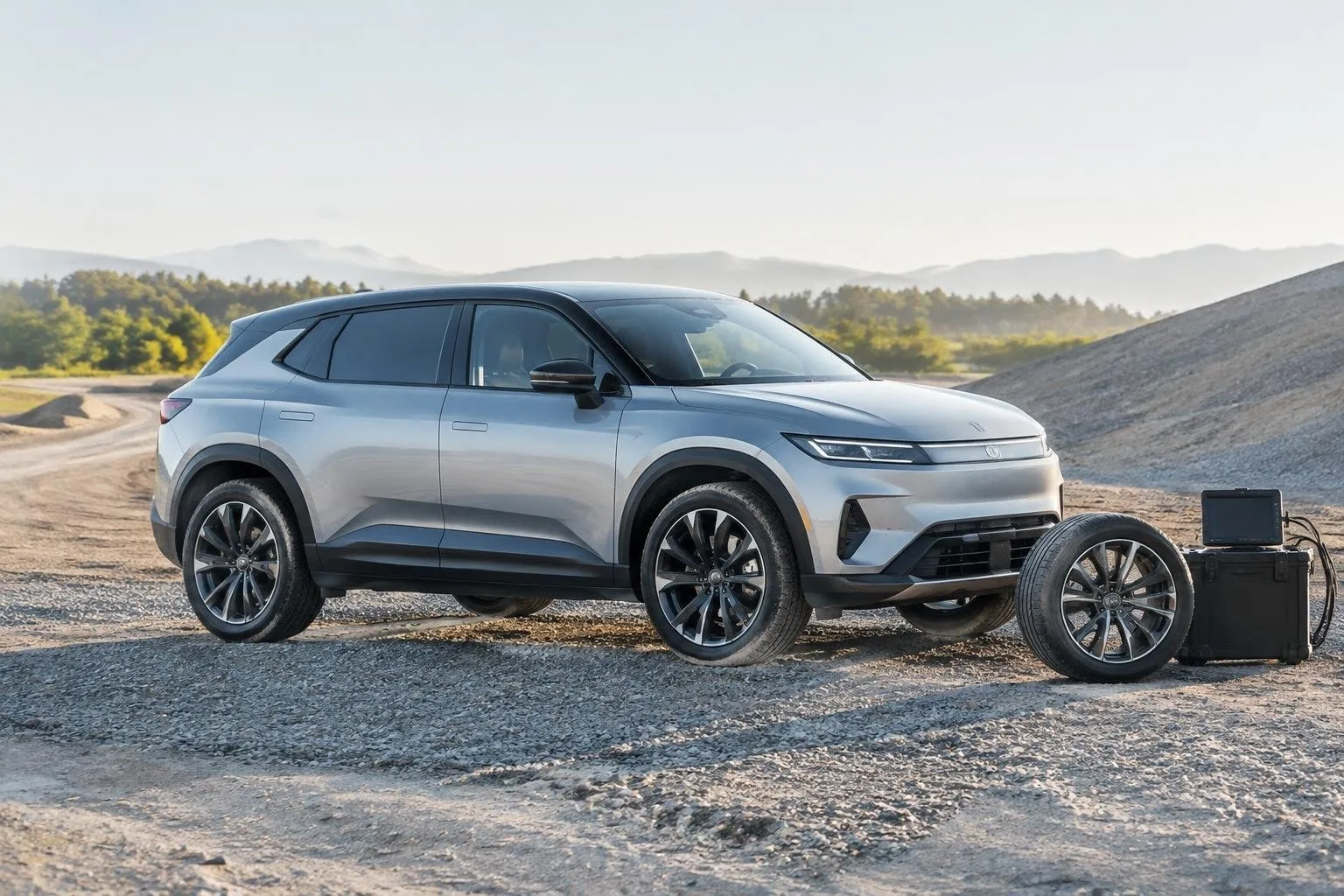
Rivian describes Rally mode as a software-driven personality that can be activated with a single press. The feature converts the electric R2 into a machine that behaves like a purpose-built rally car, yet retains the instant torque and low centre of gravity inherent to the brand’s EV architecture.
Development began with the earlier R1 and continued for the R2, where engineers spent years adjusting steering response, traction control and suspension damping to suit loose surfaces. The most decisive testing ground was the DirtFish off-road academy, a 30-minute drive east of Seattle in Snoqualmie, Washington.
Testing at DirtFish shaped the final software map
DirtFish welcomes a broad spectrum of drivers, from teenage novices to former Formula 1 champions. When Rivian’s team arrived, they placed the R2 beside both rear-wheel-drive and all-wheel-drive instructional cars, seeking to blend the nuanced feel of each into a single drive mode. Ian Duncan Jr., staff dynamics engineer, noted that the electric drivetrain supplies “instantaneous low-end torque, which is great for pulling out of a corner or initiating a slide.”
Chief instructor Nate Tennis, who usually swaps gearboxes by hand, was impressed by the simplicity of the software adjustments. He said, “It was just click, click, click on some settings and you can make a drastic change and tailor the car’s handling to exactly what you want.” The team altered torque bias, damping and roll stiffness lap after lap, observing the car’s reaction in real time.
How Rally mode manages torque and stability
Rex Gu, controls calibration engineer, explained that the mode uses a subtle, linear torque-distribution map. Under light acceleration the system leans toward a rearward torque bias, allowing the driver to steer the vehicle through a corner primarily with the throttle. When the driver is ready to exit, the bias shifts slightly forward to maximise traction on the straight. This behaviour emerged directly from the collaboration with DirtFish, where the engineers experienced both RWD and AWD dynamics.
Beyond torque allocation, Rally mode adopts relaxed stability-control limits and adaptive damper settings. The result is a smoother ride over rough terrain, letting the driver concentrate on the experience of the slide rather than fighting the vehicle’s limits. According to Gu, “Our controls should feel unobtrusive, and a driver’s input should translate naturally to car behavior.”
Driving lessons from DirtFish and the role of Rally mode
The instructional philosophy at DirtFish emphasizes weight transfer over brute throttle. Instructors teach four steps: lift, turn, wait, and exit. Lifting off the accelerator (or briefly braking) shifts weight to the front wheels, creating a controlled slide before a corner. While the car rotates, smooth throttle or brake inputs maintain the line, and the steering wheel becomes a suggestion rather than a command. Patience is essential because responses on loose ground are slower than on asphalt. Finally, once the apex is reached, the driver re-applies power, moving weight back to the rear for traction down the exit.
Rally mode embodies these principles in software. By providing a pre-set torque bias that responds to pedal input, the mode lets everyday drivers experience the same physics that DirtFish teaches. Managing weight transfer becomes intuitive, and the vehicle’s reactions reinforce the lesson each time the driver slides and accelerates.
Managing Director Brenten Kelly summed up the educational value: “Getting your driver’s license is mostly about learning the laws of the road. Taking a course at DirtFish is about learning the laws of physics.” The experience leaves a lasting imprint, much like the mud that clings to a car after a day on the track.
Whether a motorsport enthusiast or a commuter seeking confidence on rain-slick streets, Rally mode offers a toolbox for better vehicle control. A single button activates a suite of calibrated settings, turning the R2 into a platform that teaches and performs on loose surfaces.