
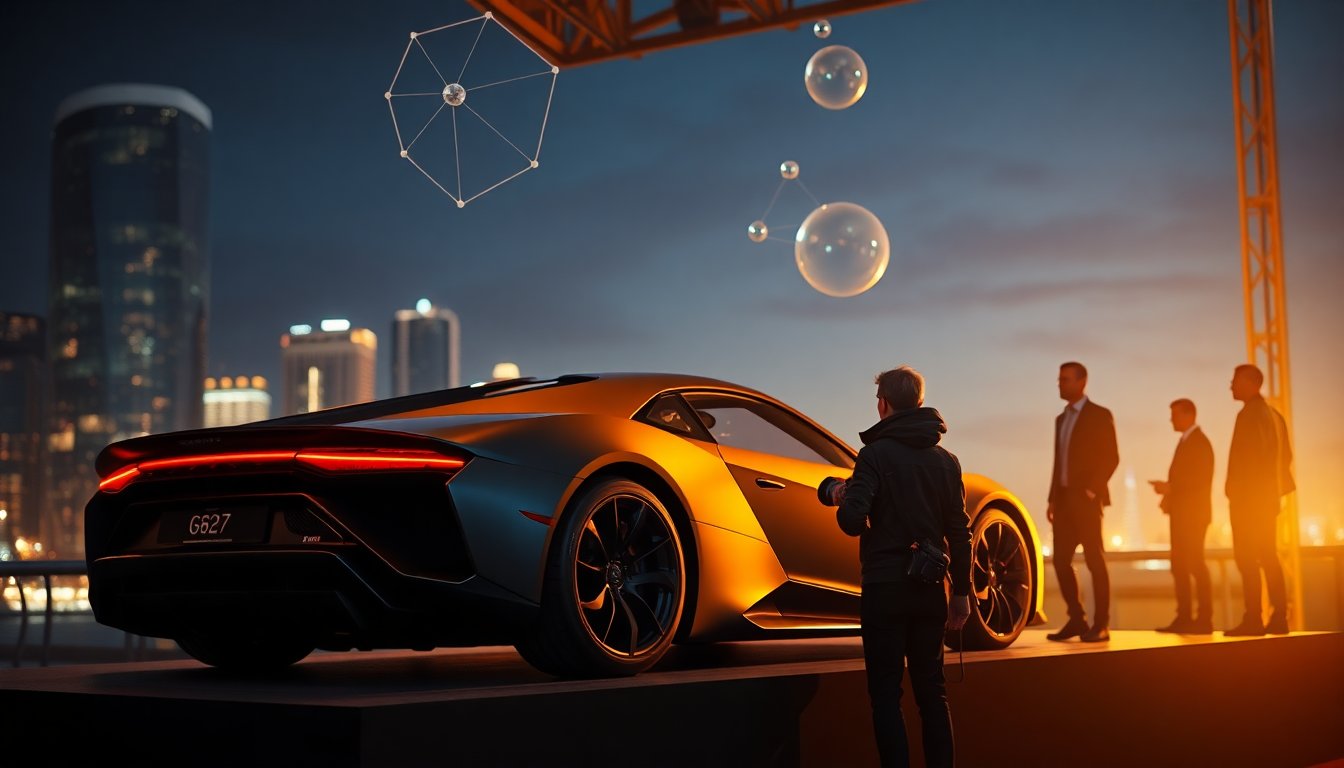
On April 21, 2026, Karma automotive made a deliberate public move to frame the future of high-end collectability at the Hong Kong Web3 Festival (April 20-23). The company displayed the Karma Kaveya supercar and engaged with media, investors, and industry leaders to discuss how physical automobiles and digital systems might be woven together. That discussion included a public panel featuring Marques McCammon, Karma’s president and CEO, and leaders in blockchain infrastructure such as Nazmus Saquib of Oak Network. The presentation highlighted both cutting-edge vehicle technology and exploratory work in digital participation mechanisms.
These conversations occur against a backdrop of a growing digital asset economy: the global cryptocurrency market now exceeds $2.5 trillion in aggregate value, and digitally native sectors like esports, online gaming, and online betting each surpass $100 billion in annual activity. Those ecosystems have normalized digitally tracked value and scarcity for younger audiences. Karma positions its effort not as an immediate shift to tokenized ownership, but as research into how a digital layer might reward participation and improve transparency in areas like provenance, service history, and resale valuation.
What Karma is building: a network token and agentic AI framework
Karma announced a collaboration with Oak Network, a Web3 infrastructure startup backed by Andreessen Horowitz, to explore a network token. The token is designed to reflect verified activity across the Karma ecosystem and to capture agentic transactions performed by AI systems that support vehicle ownership. Importantly, Karma has stated the token will not be an equity or vehicle ownership instrument; it is conceived as a participation and value exchange mechanism that complements the physical asset. Any implementation will follow applicable laws and evolving regulatory guidance.
Core mechanics and use cases
The proposed token architecture is intended to enable three primary functions. First, AI compute and analysis would use tokenized incentives to power real-time assessments of vehicle health and projected resale value. Second, the system would create immutable records on a blockchain ledger to hold verified maintenance, provenance, and valuation events. Third, the token could support operational settlement, rewarding agents for on-chain data entry and confirmed workloads. Together, these mechanisms form an agentic framework for automating complex workflows while maintaining auditability and traceable economic signals.
Kaveya as a technological and cultural statement
The physical star of Karma’s pavilion, the Karma Kaveya, functions as more than a showpiece; it represents the company’s engineering direction. Announced earlier in the year, the Kaveya is slated to be the first North American production vehicle to employ a solid-state battery, a technology that promises higher energy density and improved packaging for performance vehicles. The super-coupe is also described as producing more than 1,000 HP and featuring dramatic design elements like butterfly doors. Presenting the model at a Web3 event signals that Karma intends to pair tangible performance advances with experiments in digital ownership experiences.
Preserving craftsmanship while exploring new ownership models
Karma stressed that its commitment to handcraft, design, and performance remains central even as it explores digital ecosystems. The company previously allowed customers to reserve and purchase vehicles using the USDC stablecoin, a step that demonstrated a pragmatic approach to crypto integration. Karma also outlined plans to deploy Software-Defined Vehicle Architecture (SDVA) across upcoming models, indicating that future platforms will be software-first and designed to interoperate with third-party technology partners.
Manufacturing, lineup and next steps
Karma continues to manufacture Hybrid EREV vehicles at its Karma Innovation and Customization Center (KICC) in Moreno Valley, CA, with Executive, Product Development, and Design teams based in Irvine, CA. The company confirmed its model cadence: the Gyesera Grande Coupé (Hybrid EREV four-seater) is due in Q2 2026, the Amaris GT Coupé (Hybrid EREV) is expected in Q4 2026, the Kaveya super-coupe is planned for Q4 2027, and the Ivara GT-UV is set for 2028. These timelines reflect Karma’s simultaneous focus on physical product launches and digital experimentation.
By taking the Kaveya to the Hong Kong Web3 Festival and opening a public dialogue with technologists, investors, and regulators, Karma Automotive aims to contribute to a measured, transparent discussion about how ultra-luxury vehicles and emerging decentralized technologies might coexist. The company frames its work as an effort to define modern collectability—linking tangible advances like solid-state batteries with thoughtful digital constructs such as a network token—while staying within legal and regulatory boundaries.


