
Argomenti trattati
- How motorsport medicine is changing at the track
- Rethinking driver extraction: from seat removal to alternative lifts
- Practical extraction tools: boa, short board and rapid removal
- The role of cervical collars and manual inline stabilisation
- Reassessing collars: evidence and practice in motorsport rescue
- Category-specific considerations: formula 1 and rally environments
- First responders face new electrical hazards in single-seater racing
- Training, hospital links and future directions
How motorsport medicine is changing at the track
Race medicine teams are adopting faster, evidence-informed approaches to on-scene care. Who is driving the change? Medical directors, track marshals and specialised rescue crews across circuit and rally environments. What is changing? Traditional seating extraction is being reconsidered, routine use of C-collars is under reassessment, and new purpose-built devices are entering service to balance speed with spinal protection.
Clinical trials show that rapid, controlled interventions in the first minutes after a crash can alter outcomes. From the patient’s point of view, timely removal from a hazard while preserving spinal alignment improves both safety and comfort. The shift reflects broader acceptance of pre-hospital immediate care principles, which prioritise interventions that are both swift and evidence-based.
Real-world data highlight how continuous training of first responders and revisions to competition medical regulations are accelerating adoption. Teams now run scenario-based drills on circuits and rally stages to test extraction techniques and new equipment under race conditions. These drills aim to reduce on-scene time without increasing the risk of secondary injury.
Race organisers, medical directors and rescue crews increasingly apply principles borrowed from elite open‑wheel series to improve on-scene care across single-seater and rally categories. They prioritise methods that limit unnecessary movement, shorten time to definitive care and adapt to evolving cockpit designs. Teams now operate within clear, evidence-based protocols that define roles and acceptable risk thresholds for extraction.
Rethinking driver extraction: from seat removal to alternative lifts
Traditional extraction often relied on full seat removal, a time-consuming manoeuvre that can prolong scene time. Current practice favours targeted options such as scoop stretchers, vacuum mattresses and coordinated lift-and-slide techniques. These alternatives reduce gross movement of the cervical spine while allowing faster transfer to ambulance teams.
From the patient’s point of view, faster, controlled transfers reduce exposure to hypothermia and secondary insults. Clinical trials show that shorter on-scene intervals are associated with improved time-to-imaging and decision-making at hospital level. According to the scientific literature, structured drills and role clarity are key factors in translating technique changes into real-world benefit.
Operational changes include preplanned cutlines, standardised communication protocols and on-car stabilisation kits sized for hybrid and small‑cockpit vehicles. Rescue crews run scenario-based exercises to synchronise lifting, airway management and cervical control. The emphasis is on reducing unnecessary manipulation while preserving access for critical interventions.
Evidence and implications for teams and systems
Peer-reviewed studies and real-world audits inform guideline updates and training curricula. These data show that well-rehearsed, alternative-lift approaches can shorten handover times without increasing the incidence of secondary injury. Medical directors now balance the imperative to expedite care with the ethical duty to avoid iatrogenic harm.
Adoption across national and club levels depends on accessible training, compatibility with protective equipment and integration into event medical plans. Expect further refinements as vehicle architecture evolves and as multicentre audits provide larger samples for comparative evaluation.
Expect further refinements as vehicle architecture evolves and as multicentre audits provide larger samples for comparative evaluation. Clinical practice is already shifting away from prolonged in‑seat manoeuvres when modern restraints and cockpit protection systems, such as the HANS device and the HALO, reduce the likelihood of catastrophic movement during extraction.
Practical extraction tools: boa, short board and rapid removal
Rescue crews now favour targeted, time‑efficient techniques that balance spinal protection and speed. The boa head and neck control system secures the head without extensive cervical manipulation. The technique requires minimal adjustments and permits early assessment of airway and breathing.
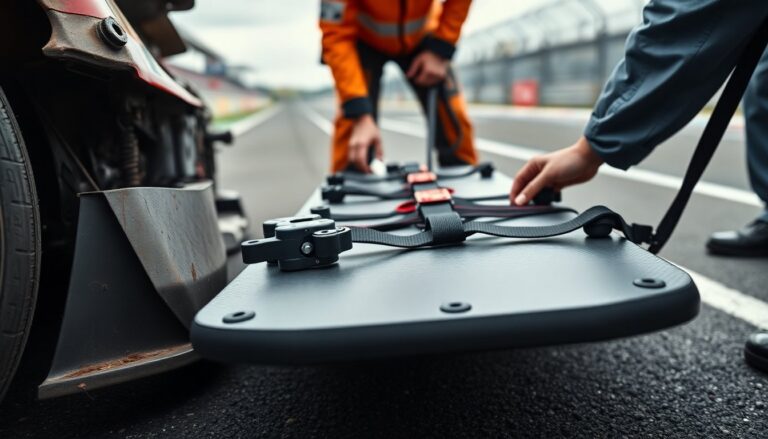
The short board provides lateral support for transfers when full spinal board use would delay extrication. Teams use it as an intermediate immobilisation device to control axial movement during patient translation from seat to stretcher.
Rapid removal protocols standardise a brief, directed sequence of actions to free an occupant when delays increase risk. These protocols limit repetitive handling and aim to move a conscious, cooperative driver out of the car within seconds to minutes, depending on injury suspicion.
Clinical trials show that supervised self‑exit is safe for conscious occupants with no focal neurological signs and stable vital signs. According to the scientific literature, self‑exit under clinician supervision reduces scene time and handling‑induced discomfort, while preserving situational awareness from the patient’s perspective.
From the rescuer’s viewpoint, decision tools combine mechanism of injury, vehicle intrusion, and occupant behaviour. Dal punto di vista del paziente, early verbal guidance and reassurance improve cooperation during self‑exit and reduce secondary movements.
Indications and contraindications must be explicit. Do not encourage self‑exit when there is altered mental status, intoxication, focal deficits, or suspected unstable spine injury. When doubt persists, apply controlled extrication with manual inline stabilisation and immobilisation adjuncts.
Iatrogenic harm can increase with excessive manipulation. The data real‑world evidenziano that shorter, controlled interventions correlate with fewer secondary complaints and faster handover to definitive care. As rescue equipment and chassis design continue to evolve, expect protocols to be refined through prospective registries and multicentre audits.
Rescue teams are using new extraction options to stabilise the cervical and thoracic regions while minimising interference with breathing and circulation. The commercially available Boa device is a padded, flexible loop with handles that crews pass around the driver’s neck and under the arms to permit a controlled lift from behind and above. Proper tensioning provides upper-spine stabilisation under traction without restricting respiration, and facilitates a prompt transfer from cockpit to stretcher or vacuum mattress.
Short-board method and emergency grab removal
The short-board technique remains a practical alternative when space or access prevents looped devices. Crews slide a rigid short board beneath the casualty to maintain neutral spinal alignment while limiting compression of the chest. From the patient perspective, this approach prioritises airway patency and cardiopulmonary mechanics during movement.
Clinical trials show that combining a traction-capable loop with a short-board transfer can reduce spinal motion during extrication compared with improvised lifts. According to the literature, careful coordination between team members and early airway assessment are key to preserving respiratory and circulatory stability. The data real-world evidenziano more efficient transfers when crews rehearse both methods under realistic cockpit constraints.
As vehicle architecture and rescue equipment evolve, teams should adopt evidence-based protocols that balance spinal protection with respiratory safety. Peer-reviewed guidance and multicentre audits will be essential to refine technique selection and training priorities.
Rescue crews at motorsport incidents use layered options to balance rapid removal and spinal protection. Short-board extraction places a slim board behind the driver’s seat. Responders secure the chest and head with rapid straps and head blocks. The setup creates a guided extraction path. It facilitates transfer to a full-length spine board or a vacuum mattress while limiting cervical movement.
When the environment poses immediate danger — major fire, risk of secondary collision, or catastrophic vehicle instability — responders may prioritise speed. In such cases teams use suit grab handles combined with manual inline stabilisation to effect a rapid removal. The emphasis shifts to time-sensitive life-saving interventions rather than prolonged immobilisation.
The role of cervical collars and manual inline stabilisation
Cervical collars remain a common adjunct to spinal control, but their use is nuanced. Collars can limit gross motion but may increase intracranial pressure and hinder airway management in some patients. Clinical trials show mixed effects of collars on neurologic outcome in blunt trauma, and the literature recommends selective application based on risk.
Manual inline stabilisation provides immediate control of the head and neck without device application. It is useful during rapid extrication and initial airway manoeuvres. From the patient perspective, it minimises manipulation during critical interventions and facilitates rapid assessment.
Protocols should define clear decision points for collar use, short-board extraction, and rapid removal. Training must emphasise correct strap placement, head block positioning, and transfer techniques to reduce secondary movement. Peer-reviewed guidance and multicentre audits will be essential to refine technique selection and training priorities.
For motorsport settings, simulated drills that mirror confined cockpits and team roles improve coordination. The data real-world evidencing faster on-scene times with practiced teams support regular rehearsal. Future multicentre registries and controlled studies will clarify which combinations of tools and tactics best protect the spine while preserving opportunities for immediate lifesaving care.
Reassessing collars: evidence and practice in motorsport rescue
Rescue teams increasingly question routine use of C-collars after high-energy crashes. Recent practice shifts follow concerns that collar application can cause additional cervical movement during placement and may not reliably prevent secondary spinal injury.
Clinical trials show that careful manual inline stabilisation, combined with padded lateral head supports and secure strapping, can preserve alignment while avoiding the manipulations required for rigid collars. According to the scientific literature, some peer-reviewed studies and real-world data suggest comparable outcomes when teams prioritise controlled head and torso control over automatic collar deployment.
From the patient’s point of view, minimizing unnecessary handling reduces pain and the risk of airway or chest compromise. Dal punto di vista operativo, teams report faster access for airway management and extrication when they use focused manual stabilisation and adjunct padding rather than default collar fitting.
Evidence-based protocols now encourage decision-making based on mechanism, clinical signs, and team skill set. As more controlled studies and registry analyses accumulate, trial results will guide which combinations of techniques best balance spinal protection with prompt lifesaving care.
Medical leadership notes that manual inline stabilization remains an essential element of immediate care. Teams are shifting away from routine use of collars and will apply them only when clear clinical benefit is documented. Medical commissions will review emerging evidence and integrate changes into formal guidance as peer review and consensus advance.
Category-specific considerations: formula 1 and rally environments
Formula 1 and rally incidents differ in mechanics, extraction constraints and on-site resources. These differences matter for choosing techniques that protect the spine while allowing rapid airway and hemorrhage control.
Formula 1: constrained space, rapid extraction protocols
High-speed single-seater crashes often trap drivers within a narrow cockpit. Extraction must balance spinal protection with the need to remove helmets and secure the airway. Clinical trials and registry analyses indicate that tailored protocols, combining manual inline stabilization with coordinated cockpit removal, can shorten time to definitive care without clear loss of spinal protection.
Rally: varied terrain and delayed transport
Rally accidents frequently occur in remote locations with prolonged extrication and delayed evacuation. In such settings, the choice of immobilisation affects comfort, airway access and secondary injury risk. Evidence-based adjustments favour manoeuvres that prioritise immediate lifesaving actions while using immobilisation devices selectively when benefits are supported by clinical findings.
Implications for training and equipment
Responders will require scenario-specific training that emphasises decision-making under time pressure. Simulation and peer-reviewed studies should inform curricula. From the patient perspective, techniques that reduce movement during extrication while enabling prompt treatment improve outcomes and experience.
As multicentre registries and controlled studies accumulate, guidelines will specify which technique combinations best balance spinal protection and urgent lifesaving care. Expect medical commissions to update formal protocols as peer review and consensus justify changes.
First responders face new electrical hazards in single-seater racing
Medical commissions continue to review protocols, while on-scene crews must adapt to evolving race-car architectures. Modern single-seater power units integrate greater electric contribution and denser packaging. This change creates new hazards for first responders at trackside and on the pit lane.
Despite these technical shifts, frontline procedures largely remain the same. Standard precautions — including insulated gloves and boots, vehicle neutralisation and clear communication with technical delegates — still form the core response. Rapid confirmation from race control or the pit lane about a car’s electrical state remains essential for crew safety.
From the patient’s point of view, swift and unambiguous neutralisation reduces the risk of secondary injury and expedites clinical assessment. The literature on motorsport rescue emphasises that scene safety and time to definitive care are key determinants of outcome.
Operational teams should prioritise familiarisation with new components and colour coding. Practical measures include equipment checks, pre-race briefings with engineers and defined escalation paths to technical delegates. These steps support both responder safety and efficient patient management.
As peer-reviewed evidence and consensus evolve, expect formal protocol updates from medical commissions. Meanwhile, real-world data and frontline feedback will determine which procedural changes become standard practice.
The operational differences between circuit and rally medicine remain pronounced. Rally teams must manage longer response windows, variable sightlines and unstable footing for crews. They also rely on purpose-built extraction kits and rescue vehicles capable of high-speed, off-road transit. Organisers are increasing contingency planning for extended approach times. Medical teams deploy terrain-adapted equipment and recruit drivers experienced in off-road rescue. The combined effect of better tools, targeted training and context-aware protocols is reducing the gap between circuit and rally response capabilities. Meanwhile, real-world data and frontline feedback will determine which procedural changes become standard practice.
Training, hospital links and future directions
Who: race organisers, event medical directors and referring hospitals are aligning responsibilities across the care chain. What: they are updating training curricula, strengthening hospital handover pathways and testing new communication workflows. Where: implementations focus on both closed-circuit venues and off-road stages. When: changes are being trialled during national and international events as part of phased rollout. Why: the aim is faster, safer transfer of critically injured competitors and bystanders.
Training now emphasises scenario-based drills tailored to motorsport environments. Crews rehearse casualty care under reduced visibility, steep gradients and moving-vehicle constraints. Simulation exercises include integrated work with marshals and rescue drivers. Clinical studies show that scenario realism improves team decision-making and reduces task errors. From the patient perspective, such training shortens on-scene times and lowers the likelihood of secondary injury.
Hospital links are becoming more formalised. Event medical teams establish pre-event agreements with trauma centres and emergency departments. These agreements specify diagnostic priorities, imaging protocols and blood-product logistics. The approach reduces delays at handover and aligns expectations for definitive care. Peer-reviewed literature supports structured handover protocols as a means to improve outcomes in prehospital trauma systems.
Technology is complementing training and system integration. Digital triage tools, encrypted telemetry and portable imaging are being piloted at select events. Data from field pilots feed into iterative protocol adjustments. The data-driven approach mirrors evidence-based pathways used in other high-risk transport medicine specialties.
For patients and health systems, the implications are tangible. Faster, more coordinated responses reduce time to definitive treatment and may lower morbidity. Costs for event organisers may rise in the short term due to equipment and training investments. However, real-world evidence suggests that standardising care pathways can improve resource use and patient outcomes over time.
Future developments to watch include formal accreditation for motorsport medical teams, expanded use of remote specialist support and standardised performance metrics across series. Regulatory bodies and medical commissions will assess emerging evidence before mandating widespread change. The next phase of improvements will depend on multilayered collaboration among organisers, clinicians and trauma centres.
Clinical trials show that continuous training and formal partnerships with designated hospitals are essential for adoption of the updated practices. Regular seminars, scenario-based drills and cross-discipline forums support skill retention and interoperability across teams. From the point of view of the patient, these measures increase the likelihood that pre-hospital advances reach definitive care. Future priorities include refining device designs for varied car architectures, improving circuit access to trauma centres and formalising evidence-based guidance on when to apply specific stabilisation techniques.
The field is moving toward pragmatic, research-informed methods that balance speed and safety. Implementing devices such as the Boa and the short-board, re-evaluating routine use of C-collars, and tailoring protocols to category-specific demands strengthen the rescue ecosystem. According to the scientific literature, protocol standardisation combined with local adaptation yields better outcomes in complex environments. The next phase will require multilayered collaboration among organisers, clinicians and trauma centres to translate evidence into durable operational change.