
Argomenti trattati
The modern sport car thrives on thoughtful modification. Whether your focus is sharper throttle response, cooler intake temperatures, or a deeper exhaust note, choosing the right component is the difference between a harmonious upgrade and wasted money. In this article we outline the core hardware that tuners reach for, explain what those parts actually do, and highlight how materials, fitment and services combine to deliver dependable results. Expect practical pointers on cold air intakes, downpipes, intercoolers, and the specialist world of external wastegates, all in the context of Mercedes‑AMG and similarly tuned vehicles.
Before you shop, it helps to know the goals behind common modifications. Some parts aim purely at airflow and thermals; others change backpressure and exhaust character; a third group involves software changes to unlock potential. We will also cover compatibility signals—engine codes, chassis families and popular model ranges—so you can match parts to your car with confidence. Throughout the piece, the term fitment will refer to how a part physically and electronically integrates with the vehicle, while flow rate will mean the volume of air or gas that can pass through a component under given conditions.
Key performance components and their roles
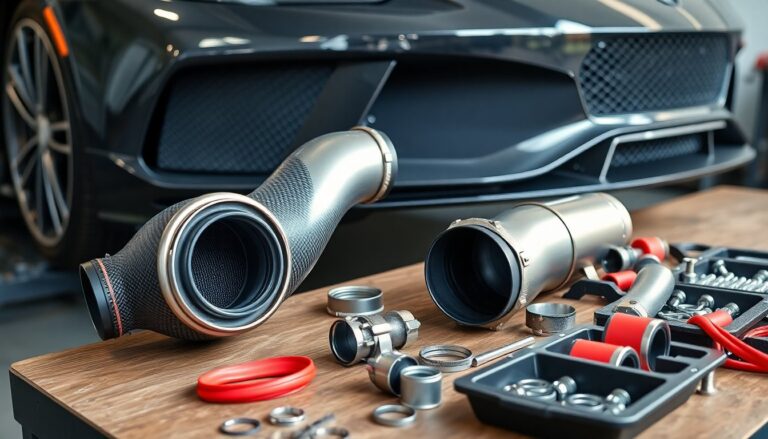
Start with the basics: a well-designed cold air intake lowers intake air temperature and reduces restriction, which can improve throttle response and torque delivery. Upstream from the intake, a larger or more efficient intercooler preserves charge density under sustained load by reducing intake charge temperatures. On the exhaust side, high‑flow downpipes and cat‑less sections reduce backpressure and help the turbo spool faster. For forced induction systems that require precise boost control, an external wastegate is often chosen to manage exhaust gas bypass and maintain consistent boost levels.
Understanding the external wastegate
An external wastegate is a valve that routes exhaust gas away from the turbine to control turbocharger speed and boost pressure. Compact designs exist that keep overall package height low while preserving high flow capacity. Quality units use materials like 253MA chromium‑nickel stainless steel for the body, CNC‑machined stainless valves and billet aluminium actuator housings. Protective design features such as internal shrouds reduce heat exposure to the valve stem and limit carbon buildup, improving longevity. Common fittings include V‑band clamps for secure, leak‑resistant attachment to turbo housings and downpipes.
Selecting parts for Mercedes‑AMG families
When shopping for parts, refer to your engine and platform identifiers to avoid mismatches. Mercedes‑AMG engines come in several families—examples include M270, M133, M139, M276, M256, M157, and the M177/M178 twin‑turbo variants (often listed as LS1/LS2 for AMG GT). Chassis groups such as the A/CLA range, C/GLC, E/GLE, AMG GT, and the G‑class require specific component shapes and software calibrations. Matching the part to both the engine code and the car’s body model prevents fitment issues and ensures proper integration with sensors and mounting points.
Model compatibility and common upgrades
Popular matchups include high‑flow sports downpipes for A45 and A35 platforms, larger cold air intakes for AMG GT applications, and full exhaust systems for two‑door GT variants to exploit gains at high rpm. Intercooler upgrades are typical for platforms where heat soak limits repeatable performance during spirited driving. Always verify whether an upgrade requires an accompanying ECU reflash or tuning to realize power gains and maintain driveability.
Materials, installation and buying tips
Material choice affects durability and thermal performance. Look for components milled or cast from high‑temperature stainless steels and aluminium alloys, with CNC machining for critical sealing surfaces. Flowformed alloy wheels are an example of a manufacturing method that balances strength and weight. Consider also the vendor services: many specialist shops offer dealer‑level fitting, software tuning, coding and personalised calibration. Brands that operate dealer networks can deliver local installation and consistent quality control.
Finally, read warranty, return and shipping policies carefully. Programs such as loyalty or rewards can offset cost, but points systems typically have expiration rules and non‑transferable terms. Choose vendors that publish clear instructions, support spare part availability, and offer technical help if you need to match intake geometry, exhaust routing or actuator specifications to your specific AMG application.
In short, effective upgrades begin with clear objectives: cooling, airflow, exhaust efficiency or boost control. Pair those goals with correct fitment, verified engine codes and reputable materials, and you’ll preserve reliability while extracting meaningful gains. If you want help deciding between a cold air intake and an intercooler for your Mercedes‑AMG, or whether a compact external wastegate suits your turbo setup, consult a specialist who can combine hardware selection with calibrated ECU tuning for safe, repeatable performance.