
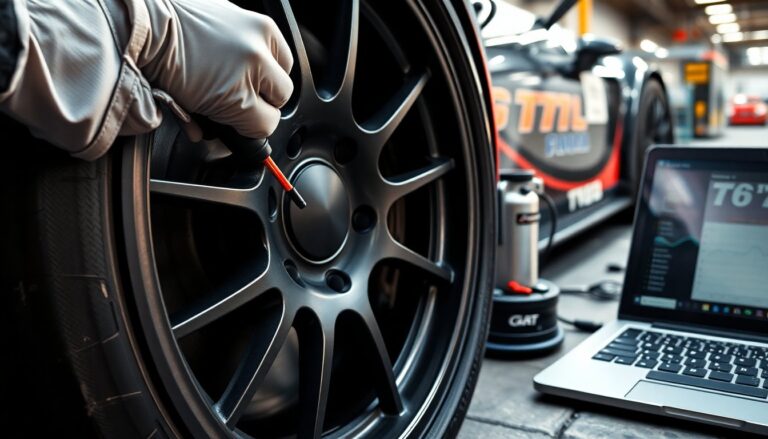
On February 19, 2026, Project Motor Racing received update 1.6.0.1 — a focused patch that overhauls the GT3 tyre model and delivers a raft of stability, input and multiplayer fixes. The studio continues its iterative, telemetry-driven approach: recent data and community reports guided this release, and drivers should expect meaningful changes at the limit that will require setup retuning.
What follows unpacks the technical changes, explains the practical effects for drivers and teams, and highlights the quality-of-life fixes included in the build.
Core physics and handling refinements
– GT3 tyre model rewrite: The headline change is a substantial revision to the GT3 tyre model. Lateral and longitudinal grip curves were rebalanced, transition behaviour in the tyre’s working range was smoothed, and load-sensitivity profiles were refined. The goal is a more consistent tyre response across fuel loads and track temperatures, reducing sudden, unpredictable breakaway behaviour.
– Chassis tuning to match tyres: Dampers and anti-roll coupling were retuned to better suit the new tyre characteristics and to minimise abrupt load transfers that previously triggered sudden grip loss.
– Driver-facing effects: Expect different mid-corner understeer characteristics and a modified on-throttle rotation profile. Aggressive camber or toe setups that previously extracted peak grip may now need to be softened to stay inside the updated tyre window.
Drivability and warm-up strategy
– Throttle and downshift logic: Throttle response has been smoothed to reduce torque spikes during fast pedal inputs. A revised downshift protection routine now tolerates brief over‑rev events within a defined allowance, protecting the engine while letting drivers remain in control. Automatic gear handling and throttle-blip assistance were also stabilised to prevent oscillations that caused transient traction loss.
– Tyre warm-up: Target pre‑heating temperatures have been lowered globally, which delays the window for optimal initial grip in short sessions. Teams and solo drivers should change warm-up routines and plan probing laps earlier to identify grip evolution.
– Practical guidance: Use progressive steering and throttle inputs in the opening laps, and avoid aggressive downshifts until tyres and engine temperature stabilise. For setup work, prioritise consistent tyre temperatures rather than peak grip on initial long runs.
GT3 tyre model: what changed and why it matters
– The technical adjustments: Carcass stiffness was moderated to reduce severe load transfer under heavy cornering. The contact patch model was refined to produce steadier lateral force progression as slip increases. Hysteresis and thermal-conductivity parameters were retuned to alter warm-up behaviour and steady‑state temperatures.
– On-track consequences: Lateral force now builds more gradually, which reduces snap-understeer or snap-oversteer near the limit and narrows tyre temperature spread across a stint. The
– Setup recommendations: Start from a neutral camber baseline and make small incremental changes to toe and anti‑roll balance. During validation runs, log lateral load vs slip curves at several compound temperatures to verify the model against telemetry. KPIs to watch: lap‑time variance, front‑to‑rear temperature differential, and grip drop per lap.
Electronics — traction control and ABS
– Smoother intervention: Traction control and ABS logic were retuned to blend intervention more gradually with tyre slip dynamics. Traction now reduces torque progressively as longitudinal slip rises; ABS modulation follows a refined slip target instead of a hard threshold.
– Haptic improvements: Wheel-and-pedal users will notice clearer, earlier force-feedback cues that reflect progressive slip buildup, giving drivers more time to react to approaching limits.
– Sim setup tips: Consider slightly higher brake bias where ABS moderates earlier, and reduce aggressive TC maps so the new progressive logic can operate effectively. Track these metrics: brake pressure histograms, peak slip angles, and force-feedback event timing.
Class-specific updates and vehicle systems
– LMDh: Complete traction-control rework. Usable TC range widened (roughly 2–10), downshift protection improved, and a bug that could stall the engine in neutral was fixed. These changes aim to reduce abrupt torque interruptions and preserve corner-exit momentum.
– GTO: TC relaxed to give more driver influence and reward throttle modulation and refined setups.
– Group 5 / Group C: Adjusted slip angles and increased clutch slip on downshifts to stabilise rear behaviour during aggressive deceleration.
– Practical approach: Retest pre‑patch setups for GT3 and other classes; parameters that compensated for the old tyre model can now induce unwanted balance shifts. Use combined-input tests and log wheel slip, steer angle and brake pressure to identify which settings need revision.
Input, force feedback and UI fixes
– Logitech TrueForce: Disabled by default on PC to avoid inconsistent tactile behaviour for users who do not expect it.
– Force feedback: GT3 FFB strength rebalanced to create a more consistent baseline; wet‑track FFB was also improved.
– UI and telemetry: Fixed a mouse-setup selection bug, corrected UDP data output, and resolved MoTeC number-flicker issues. MoTeC now receives accurate tyre temperature data, improving telemetry reliability for setup work and driver coaching.
Multiplayer, AI and tracks
– Multiplayer stability: Fixed issues that caused opponent cars to ghost and resolved a problem that occasionally placed players in the wrong lobby—improvements aimed at restoring consistent matchmaking and in-race visibility.
– AI behaviour: AI lines and overtaking behaviour were refined across circuits; São Paulo grid capacity was increased to allow up to 32 AI vehicles on PC. Penalty trigger zones were tuned for more predictable enforcement.
– Track performance: Tree rendering and placement optimised to reduce frame-rate impact while retaining visual fidelity.
Visuals, telemetry and presentation
– Vehicle art and replays: Multiple minor art fixes reduced clipping and texture anomalies; driver animations were refined for smoother replay and broadcast presentation.
– Telemetry polish: Correct tyre temperature reporting to MoTeC gives teams more trustworthy data when validating setups and coaching drivers.
What follows unpacks the technical changes, explains the practical effects for drivers and teams, and highlights the quality-of-life fixes included in the build.0
What follows unpacks the technical changes, explains the practical effects for drivers and teams, and highlights the quality-of-life fixes included in the build.1
What follows unpacks the technical changes, explains the practical effects for drivers and teams, and highlights the quality-of-life fixes included in the build.2
What follows unpacks the technical changes, explains the practical effects for drivers and teams, and highlights the quality-of-life fixes included in the build.3