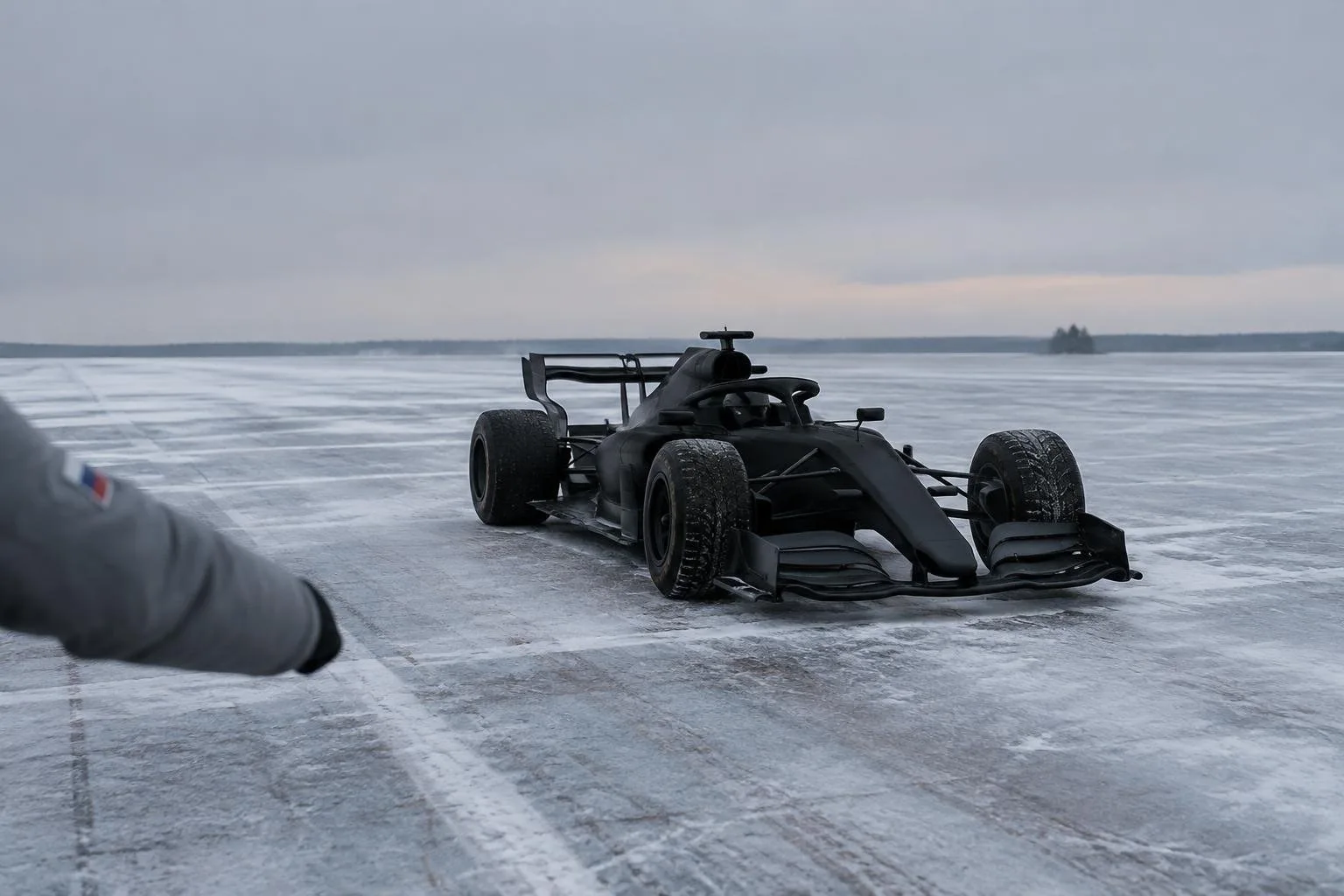
The Red Bull Ultimate Winter Race assembled five high-profile competitors on the frozen surface of Dollar Lake at Eagle River, Wisconsin, for a single-day contest. The field included Dani Pedrosa on a modified MotoGP bike, Gunnar Sterne on a snowmobile, Andrew Carlson in a Pro 4 trophy truck, Patrick Friesacher piloting an RB7-style F1 machine, and Scott Speed in a rally car. The event took place on February 26, 2026, and placed each vehicle on a dedicated course designed to test traction, control, and the riders’ ability to adapt.
Temperatures around -17°C affected how machines behaved and how teams prepared. Organizers varied course lengths and offered inside shortcuts so competitors from non-winter disciplines could have a plausible line to compete with winter-specialized machines. The format emphasized driver skill in interpreting a slippery surface rather than outright vehicle advantage.
Vehicles, course design and specific adaptations
Each competitor tackled a route tailored to their machine. The MotoGP rider used a KTM fitted with one-inch spiked tires, shortened suspension to prevent the spikes from contacting the radiator, heated handlebars, and engine tuning for cold operation. The F1 entry ran with modified tire mapping and adjusted ride height, and the Pro 4 truck carried a ramp that produced a substantial jump at the start of its circuit. The snowmobile and rally car followed longer loops and high-speed straights suited to their setups.
The organizers sought to balance the field by creating distinct challenges: tighter, technical corners for the motorcycle; a launch for the truck; long straights and quick directional changes for the rally car; sustained speed sections for the snowmobile; and a torque- and traction-limited run for the F1 car. These choices highlighted differences in braking zones, cornering approach, and acceleration on ice.
Preparation, technique and how each driver adapted
Dani Pedrosa arrived with prior practice on snow using the KTM and its long studs. On ice he worked on cornering lines and confidence levels, increasing lean and throttle input gradually until he found the limit. Pedrosa emphasized precise line selection through close, sharp turns and relied on the spiked tires to maintain grip where a slick tire would fail.
Andrew Carlson brought off-road experience that began with snowmobiles at an early age and translated into control of the Pro 4 truck. He tested several stud patterns before settling on a set for the event. The truck’s jump required mental adjustment; once he cleared it the first time, he said the run felt more natural and allowed him to focus on rhythm rather than uncertainty.
Scott Speed drove a rally-spec car with cockpit heating, which he appreciated in the cold conditions. He encountered visibility issues he had not expected, and the layout forced him to balance acceleration down straights with precise placement through right-angled turns and exit curves. Speed drew on a varied career across Formula One, NASCAR and rallycross when judging risk and throttle application.
Gunnar Sterne competed on a Ski-Doo snowmobile and relied on long experience in ice oval environments. His course was the longest and contained looping sections that demanded small steering corrections and constant weight shifts to maintain top speed. Sterne noted that familiarity with ice behavior and anticipation of surface changes were decisive.
Patrick Friesacher started from the grid in an RB7-like F1 car and struggled initially with traction during launches, spinning the wheels before building speed. His team adjusted engine mapping between runs, and he reflected that stud length affected performance; he would prefer longer spikes if repeated. On one run the engine misfired, which limited his final pace.
Race dynamics, observations and the final result
The event demonstrated how ice acts as an equalizer by limiting raw mechanical advantage and rewarding drivers who could translate experience into subtle inputs. Course preparation and temperature influenced traction across the day. For some entries the challenge was how to start or accelerate cleanly; for others it was how to carry speed without sliding off the line.
Competitors commented on the spectacle: the Pro 4 truck’s launch drew particular attention, the motorcycle’s extreme studs were visually striking, and the variety of machines on the same frozen venue provided a rare side-by-side comparison of different motorsport approaches. Drivers said they gained mutual respect from seeing how each discipline solves the same basic problems of grip and control.
When the laps were complete, Dani Pedrosa crossed the line first on the studded KTM, using tight lines and steady acceleration through the technical sections. The RB7-style F1 car finished in a podium position after recovering from traction issues. The snowmobile also placed on the podium, reflecting its natural advantage on the frozen surface. Participants highlighted the experience as unique in motorsport and informative about vehicle-specific limits when applied to ice.
The Red Bull Ultimate Winter Race at Eagle River presented a controlled experiment in comparative driving: five machines, five bespoke tracks, and a single shared surface that forced drivers to adapt their usual techniques to a surface where traction is scarce and small inputs matter most.