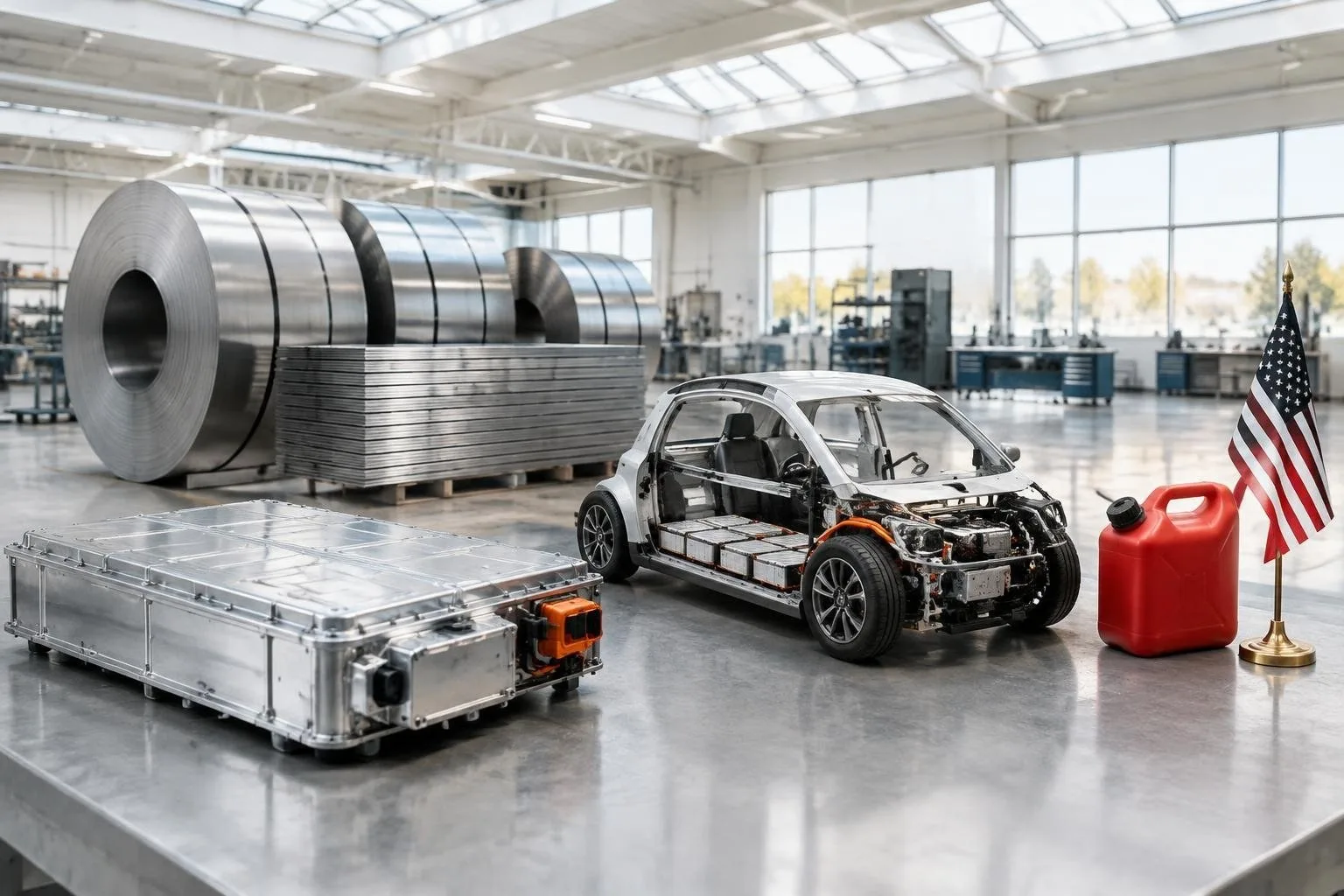
The United States has pursued a series of measures that, on the surface, aim to shield domestic automakers. Higher import duties, a rollback of Corporate Average Fuel Economy (CAFE) standards, and the removal of the federal electric-vehicle tax credit were presented as short-term fixes for a market under pressure. In practice, they have raised vehicle prices, discouraged efficient-technology investment, and reshaped supply chains in ways that may lock the industry into a less competitive niche.
Import tariffs increase the sticker price of many models sold in the United States because most brands blend components manufactured across borders. A vehicle assembled in the Midwest might receive an engine from Mexico and a battery pack from Canada; if any of those parts cross a tariff line, the final cost to the consumer rises. Low-cost models, which often rely on North-American supply chains under the United States-Mexico-Canada Agreement (USMCA), feel the impact most acutely, eroding the price advantage that once helped them compete with foreign rivals.
Policy choices and immediate market effects
When legislators introduced higher duties on Chinese, Korean and Japanese imports, the expectation was that higher prices would nudge buyers toward American-built cars. However, the domestic response has been mixed. The rollback of CAFE standards, justified by the claim that low-emission vehicles cost more to produce, actually lowered the regulatory pressure to improve fuel efficiency. At the same time, the federal EV credit of $7,500 was eliminated, removing a critical incentive for consumers to adopt electric models.
Consequently, manufacturers such as Ford, General Motors and Stellantis have trimmed their electric-vehicle line-ups. Production plans for models like the Mustang Mach-E, Chevrolet Equinox and Chevrolet Blazer, vehicles built in Mexico, now face added tariff costs that diminish their profitability. The combination of weaker fuel-economy rules and vanished tax credits weakens the business case for scaling up electric production, leaving the United States dependent on larger, less efficient vehicles just as global demand shifts toward electrification.
North-American capacity surge and its risks
Despite the policy headwinds, major automakers continue to pour billions into new factories across the United States. Honda announced a $3 billion, 240,000-vehicle-per-year plant in Ohio slated for 2029, while Toyota, Audi, Hyundai, Rivian and Volkswagen have similar expansion plans in Texas, Georgia and South Carolina. At the same time, legacy players are reviving idle plants to boost pickup and SUV output.
These investments push the continent’s utilization rate well below the 80 % threshold generally required for sustainable profit margins. Current capacity is running at roughly 69 % of its potential, according to independent analysis. Adding more assembly lines without corresponding demand creates an oversupply that forces manufacturers to discount vehicles, squeeze margins and risk inventory glut. The situation mirrors a classic “capacity binge” where production capacity outpaces market growth, a condition that has historically led to plant closures and job losses.
China’s rise and the global competitive landscape
While the United States wrestles with tariffs and excess capacity, China has become the world’s leading car producer, churning out over 7 million vehicles in the first quarter of 2026: almost double the combined output of the European Union and the United Kingdom. The Chinese advantage stems from a long-term strategy that merged aggressive manufacturer subsidies with consumer incentives for electric vehicles, creating a self-reinforcing ecosystem.
European and American regulators have begun imposing tariffs on Chinese-made electric models to counteract a flood of low-priced imports. Yet the underlying issue for U.S. automakers is not only external competition; it is the internal misalignment of policy incentives that hampers the development of globally competitive, efficient vehicles. If domestic firms remain locked into high-cost, tariff-laden supply chains while foreign rivals benefit from coordinated, long-term support, the United States risks losing market share both at home and abroad.
To preserve a viable industry, policymakers would need to move beyond import restrictions and instead enable a North-American value chain that can compete on cost, technology and scale. Without such a shift, the protective measures currently in place may paradoxically accelerate the decline of the very manufacturers they were meant to safeguard.