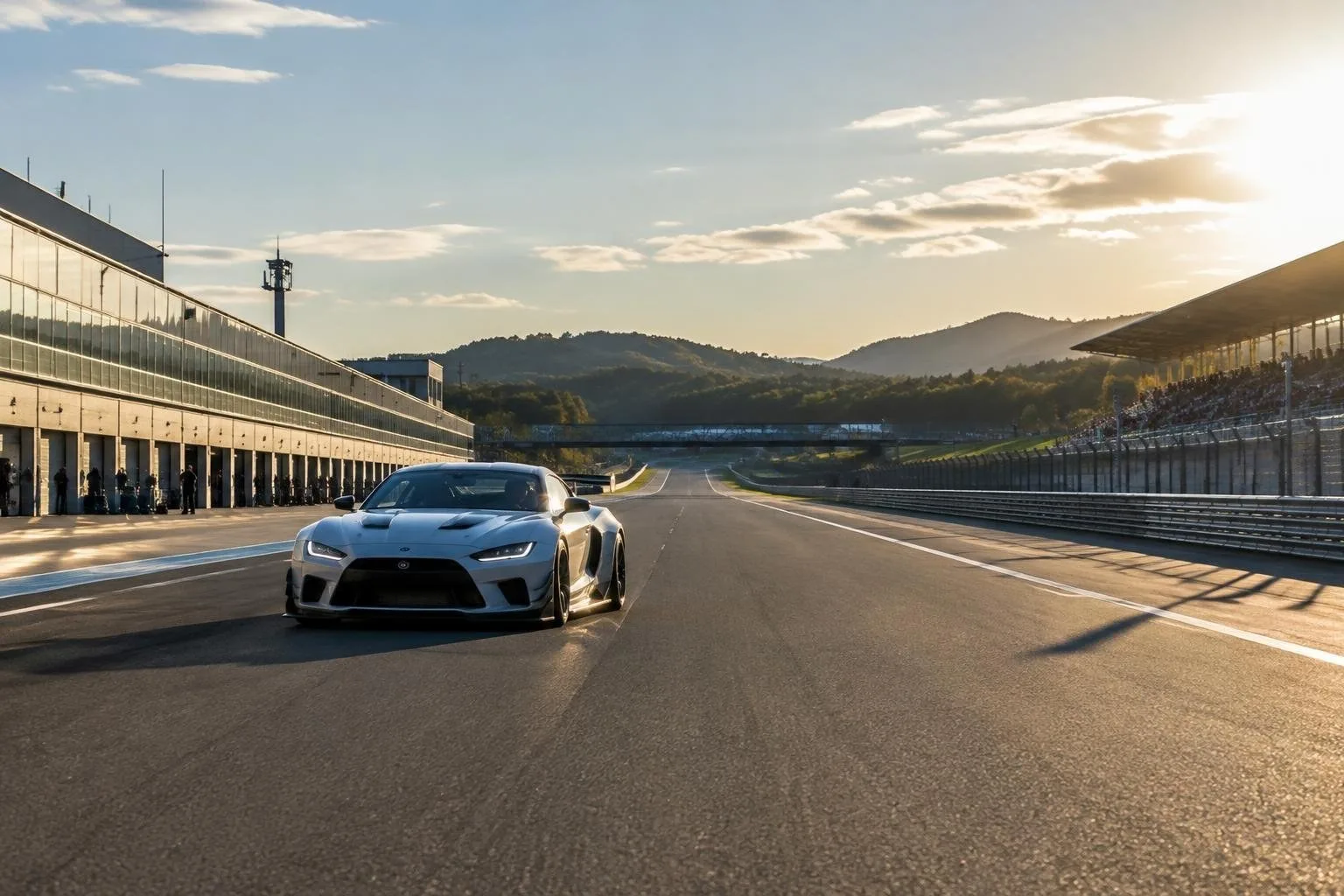
Toyota’s mid-engine prototype, the Concept M, went back to the track at the Okayama round of the Super Taikyu series, where it appeared as car No. 28 and drew attention well beyond the paddock. The car is a GR Yaris-based coupe built to test how the engine position changes the way a car behaves.
Round 6 of the 2026 Super Taikyu Series took place at Okayama International Circuit on October 24 and 25, a year after the car first entered the series. The Concept M had since raced at the Fuji 24 Hours in May (Round 3) and at Sportsland SUGO (Round 4), so this outing was its third competitive stage of the year.
A coupe silhouette to test airflow
For this race, the car looked different from its earlier versions. Speaking to reporters on October 24, Tomoya Takahashi, president of Gazoo Racing, explained the change: “I think car No. 28 will surprise people. It’s a coupe-like car styled after the GR Yaris,” he said.
Until now the team had used the GR Yaris body itself. This time it brought a coupe-like silhouette to see how the shape changes airflow, and how a slight shift in front-to-rear weight distribution affects handling. The rear emblem carries the kanji 風 (fū), meaning “in the style of”, reportedly handwritten by driver Masahiro Sasaki.
Cooling is the main obstacle
According to Takahashi, cooling and heat management have been the biggest problems since the car first ran on track. Moving the engine farther back makes it physically hard to get enough air into the engine bay. Handling and dynamic performance also caused trouble, but he said most of the issues come down to aerodynamics and airflow.
The team’s main goal at Okayama was to measure how much the new silhouette helps air reach the rear of the car. Takahashi said the team has learned at least that the new shape seems to improve cooling compared with the previous setup. Air channelled under the car is also central to downforce, and the front end was reshaped to direct flow underneath, with particular attention paid to the front lip and its height off the ground.
The limit is the engine itself. It sits relatively high, so the air flowing under the car cannot reach it. Air can be guided to components close to the underbody, such as the transfer case, which distributes power from the transmission to the front and rear axles, but the engine is harder to reach.
A road car still far off
Gazoo Racing’s view of a production version is more cautious. In a Toyota Times interview from the Okayama round, Takahashi said: “As far as development goes, I’d say we’re 70 to 80 percent of the way to understanding what putting the engine in the middle does to the car. As for a production car, however, I don’t think we’re even halfway there yet.” Reports of a rumored Toyota MR2 launch were therefore likely overstated, at least on the basis of what the team said at the track.
Takahashi also framed the programme as a matter of enthusiasm. He argued that cars are objects of passion and that people will keep loving the thrill of driving, and he stressed that the view comes from an executive at one of the world’s largest automakers rather than from a small niche brand. Gazoo Racing is now a separate sub-brand, but it remains under the Toyota umbrella.