
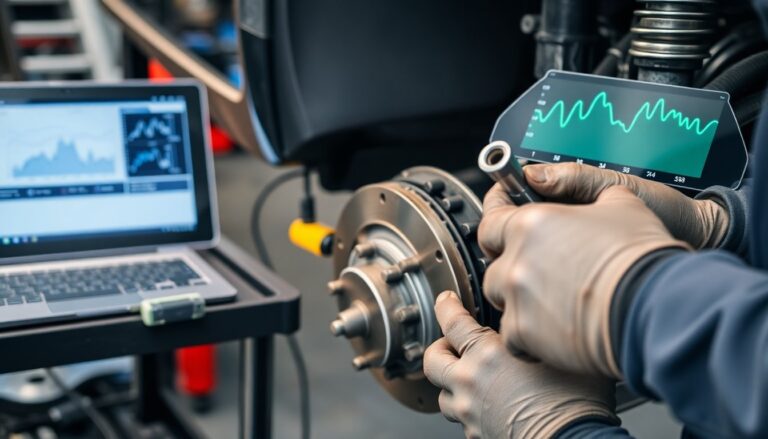
A quiet revolution is reshaping automotive repair. Where wrenchwork used to be the dominant skill, today’s technicians split their time between grease and code: they still pull apart brakes and suspensions, but they also spend hours probing on-board computers, interrogating electronic control units, and interpreting live data streams. Modern cars are networks of sensors, modules and hybrid drivetrains that require both traditional craftsmanship and digital fluency. That shift is visible in training programs, certification standards and everyday shop routines—forcing instructors, employers and students to rethink what it means to be “shop ready.”
Why this matters
– Vehicles now embed complex networks and high-voltage systems that can’t be diagnosed with a meter and intuition alone.
– Fault codes and live data increasingly direct troubleshooting; intermittent problems are often revealed only through sustained data capture.
– As a result, repair bays look different: oscilloscopes, manufacturer scan tools and laptops sit alongside torque wrenches and welders.
Evidence from training and accreditation
Curricula have changed to reflect the hybrid reality. Accredited programs now pair classroom theory with extensive hands-on practice so students can learn both mechanical procedures and the logic behind vehicle networks. Accreditation bodies such as NATEF/ASE have updated competency frameworks to test not just manual dexterity but also diagnostic reasoning and software skills. Training centers emphasize manufacturer service literature, subscription repair databases and OEM diagnostic platforms as essential learning resources.
In workshops, students routinely use scan tools, oscilloscopes and bench-test rigs to verify control units. Assessments are likewise blended: instructors grade physical repair accuracy and the ability to interpret fault codes and live data. Many programs also cultivate partnerships with local shops and OEMs to provide authentic work experience and access to licensed diagnostic software that might otherwise be out of reach for smaller schools.
How programs sequence learning
Most pathways move from hands-on basics to complex electronic diagnostics:
– Introductory modules cover shop safety, hand tools and basic engine systems.
– Intermediate units introduce fuel systems, ignition, emissions work and component-level measurement techniques.
– Advanced coursework focuses on vehicle networks, sensor theory, battery management and software updates.
Capstone projects and supervised placements test students on full-service cycles: fault capture, consulting digital service information, executing repairs, and validating systems after calibration or reprogramming.
Who’s shaping the change
Three groups are central: educators (community colleges and vocational schools), certifiers (NATEF/ASE and similar bodies) and industry partners (OEMs, tool suppliers and local employers). Colleges supply facilities and instructors; manufacturers provide technical bulletins, training packs and, under agreements, access to service platforms; shops offer internships and real-world cases. Tool and software vendors also influence what skills are taught by supplying the platforms students will use on the job.
Practical implications for the workforce
Graduates from integrated programs enter shops faster and with broader capability: they troubleshoot more efficiently, reduce vendor escalations and are less likely to produce return visits. But gaps persist. Smaller independent shops may lack OEM subscriptions or advanced diagnostic gear, creating a two-speed sector where some technicians can practice full-spectrum diagnostics and others cannot. For schools, the trade-off is balancing investment in expensive equipment and instructor upskilling against maintaining core mechanical competencies.
Day-to-day diagnostics: a clearer workflow
Successful programs teach a repeatable diagnostic loop: inspect, capture fault codes, analyze live data, perform targeted mechanical tests, then reprogram or recalibrate as needed. Trainees learn to document each step and justify interventions, reducing guesswork and unnecessary parts replacement. Shops that standardize such workflows report fewer follow-ups and faster root-cause resolution.
Program administration and student support
Managing these programs requires coordination. Intake and credential verification funnel students into appropriate modules; placement coordinators arrange supervised shop experiences; student services handle counseling and logistics. Named staff—executive directors, assistant principals, counselors and work-based learning coordinators—often form the backbone of regional initiatives, but heavy reliance on a small leadership team can pose continuity risks if turnover occurs. Clear documentation, employer agreements and performance metrics are essential to scale without losing quality.
Partnership networks and regional models
Regional consortia expand capacity by pooling resources across districts. Memoranda of understanding outline shared lab access, maintenance responsibilities and cost allocations. Advisory boards with employer representatives provide feedback, and quarterly reviews track certification rates, placement figures and employer satisfaction. Shared infrastructure lowers per-student costs but introduces scheduling and transport challenges that programs must manage.
Why this matters
– Vehicles now embed complex networks and high-voltage systems that can’t be diagnosed with a meter and intuition alone.
– Fault codes and live data increasingly direct troubleshooting; intermittent problems are often revealed only through sustained data capture.
– As a result, repair bays look different: oscilloscopes, manufacturer scan tools and laptops sit alongside torque wrenches and welders.0
Why this matters
– Vehicles now embed complex networks and high-voltage systems that can’t be diagnosed with a meter and intuition alone.
– Fault codes and live data increasingly direct troubleshooting; intermittent problems are often revealed only through sustained data capture.
– As a result, repair bays look different: oscilloscopes, manufacturer scan tools and laptops sit alongside torque wrenches and welders.1
Why this matters
– Vehicles now embed complex networks and high-voltage systems that can’t be diagnosed with a meter and intuition alone.
– Fault codes and live data increasingly direct troubleshooting; intermittent problems are often revealed only through sustained data capture.
– As a result, repair bays look different: oscilloscopes, manufacturer scan tools and laptops sit alongside torque wrenches and welders.2
Why this matters
– Vehicles now embed complex networks and high-voltage systems that can’t be diagnosed with a meter and intuition alone.
– Fault codes and live data increasingly direct troubleshooting; intermittent problems are often revealed only through sustained data capture.
– As a result, repair bays look different: oscilloscopes, manufacturer scan tools and laptops sit alongside torque wrenches and welders.3
Why this matters
– Vehicles now embed complex networks and high-voltage systems that can’t be diagnosed with a meter and intuition alone.
– Fault codes and live data increasingly direct troubleshooting; intermittent problems are often revealed only through sustained data capture.
– As a result, repair bays look different: oscilloscopes, manufacturer scan tools and laptops sit alongside torque wrenches and welders.4