Sim racing performance begins with a few high-impact choices rather than an expensive list of components. This guide lays out a step-by-step blueprint to assemble a pro-level rig on a practical budget, concentrating on the factors that deliver the most lap-time value: the wheelbase, the pedal feel, cockpit rigidity, display choices and fine-grained force feedback (FFB) tuning. Readers gain a prioritized build path and sensible upgrade steps as skills and budget grow.
Choose a wheelbase that gives realistic feedback per dollar
Start by selecting a strong foundation: the wheelbase. A direct-drive unit offers the best torque and fidelity but at high cost; a high-quality belt- or gear-driven base typically gives the best value for most drivers. Prioritize bases with consistent low-speed torque and a wide torque envelope so that FFB settings translate into usable cornering cues. Look for bases with at least 6 to 8 Nm of peak torque if budget permits, or 2 to 4 Nm for entry-level belt-drive options. Wheelbase performance matters more for lap times than exotic wheels or cosmetic upgrades, so allocate 30–40% of the initial budget here.
Invest in pedals for modulation and braking control
Pedals are the second biggest driver of lap-time gains. Replace stock units early with a three-pedal set that offers a load cell or hydraulic brake, progressive travel and adjustable pedal stops. A quality load cell brake provides consistent pressure feedback and prevents the sudden locking that plastic potentiometer pedals can cause. Focus on pedal feel: adjust the travel and leverage to match the driver’s braking style, and set a firm pedal slope to encourage smooth trail braking. Budget models with modular upgrade paths (add-on load cells or improved springs) are the most cost-effective long term.
Build a rigid cockpit to make inputs repeatable
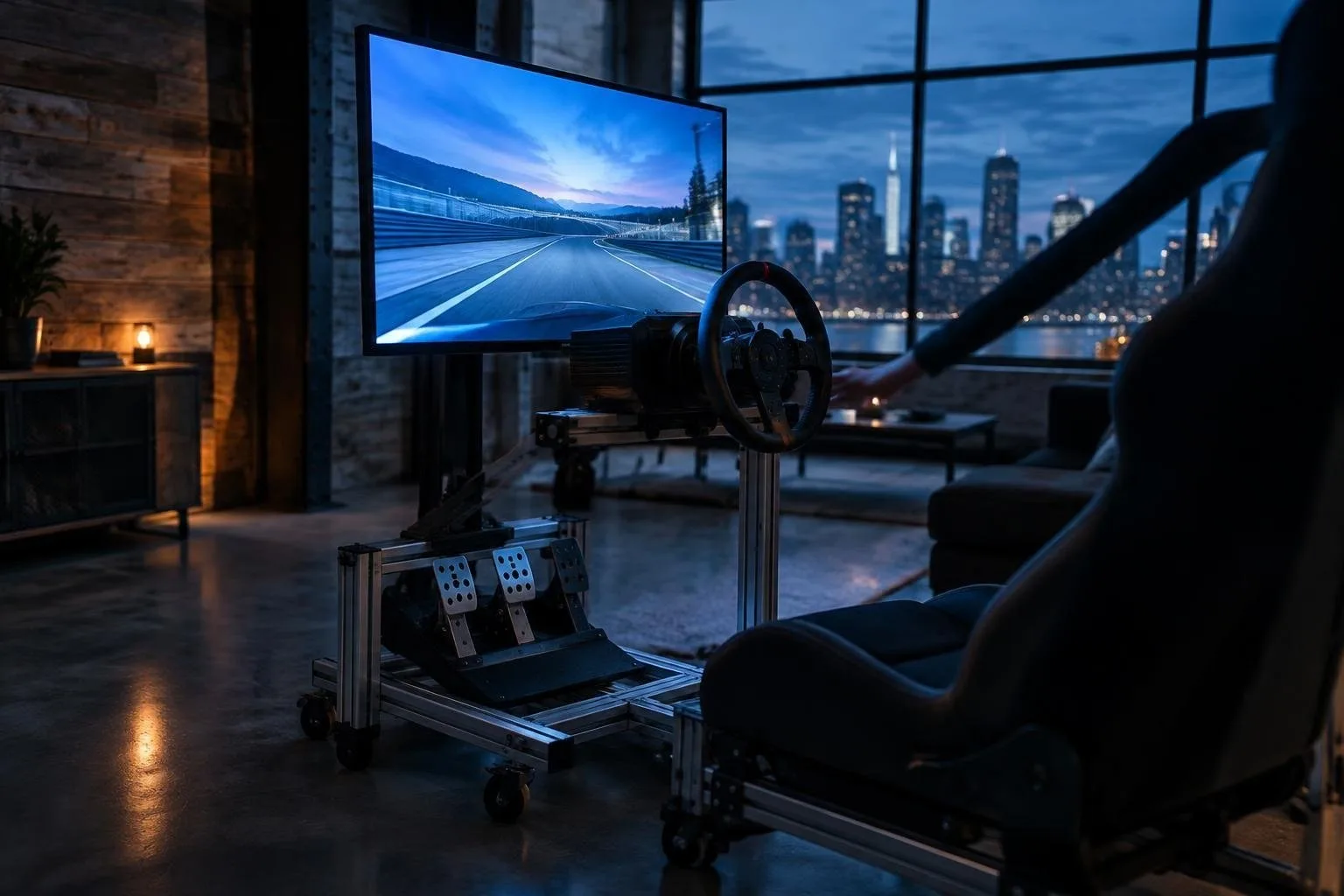
Cockpit rigidity amplifies every component’s effectiveness. A flexing rig dilutes FFB fidelity and spoils pedal and steering consistency. Invest in a welded frame or high-quality bolted cockpit with triangulated supports for the wheel mount and pedal platform. Prioritize a robust wheel mount that keeps the base fixed to avoid movement under torque spikes. Seat position and ergonomics matter: mount pedals and wheel so the driver’s hips and shoulders form consistent lever arms for input. A well-designed cockpit costs less than upgrading a wheelbase and yields disproportionate improvements in control precision.
Screens versus VR: allocate display budget for performance
Display choice affects situational awareness and comfort. Triple-monitor setups give a natural peripheral view and are cost-effective for racecraft and reference points like apexes and braking markers. A single ultra-wide also performs well for immersive horizontal field of view. Virtual reality (VR) provides superior immersion and depth perception for car control, but it demands a stronger PC and can cause motion discomfort for some drivers. For maximum performance per dollar, start with a strong monitor setup and a midrange GPU; upgrade to VR once lap consistency and sensory tolerance justify the added cost.
FFB tuning: extract usable information without saturation
Tune FFB to convey grip transitions and load changes rather than raw torque. Begin with a low overall gain to avoid clipping, then increase mid-frequency content to accentuate kerbs and tire slip. Reduce damping that hides high-frequency details and use a steering multiplier to match wheel circumference to in-game conditions. Apply a virtual steering damper sparingly: it helps stabilize feedback but can mask subtle tire breakaway cues. Keep a test protocol of short consistent laps while adjusting one parameter at a time to measure changes in feel and lap times.
Planned upgrade path as skills and budget grow
Sequence upgrades for maximum return: first, swap pedals for a load cell and firm up the cockpit; next, move to a stronger wheelbase as pedal control and setup knowledge improve; then, refine displays or add VR once the driving foundation is solid. After those core upgrades, add advanced items like quick-release wheels, handbrake or a sequential shifter. Maintain modularity: choose components with known compatibility and resale value so upgrades do not become sunk costs. Track lap-time changes after each upgrade to validate spending decisions and refine priorities.
Practical checklist and tuning routine
Use a brief checklist before every session: confirm wheelbase firmware and angle calibration, verify pedal travel and brake deadzone, check cockpit bolts for tightness and validate monitor or headset refresh rates. For tuning, keep a log of FFB presets, tire pressures and gear ratios so adjustments are repeatable. As a concrete target, aim to reduce hardware-induced input variance before investing in the next component; consistent inputs produce more reliable lap-time gains than marginal hardware swaps.
For a realistic budget that balances performance and longevity, plan expenditure across three tiers: entry (quality belt base, load-cell-ready pedals, stable cockpit), intermediate (direct-drive or high-torque belt base, true load cell, multi-screen or VR), and aspirational (top direct-drive base, pro-grade pedals and full motion or advanced telemetry). Prioritize learning and tuning between upgrades so each purchase yields measurable performance improvements.