
Argomenti trattati
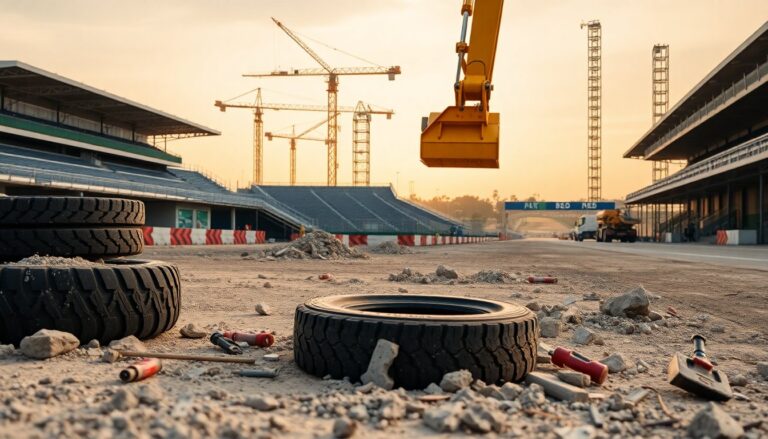
The historic Oscar y Juan Galvez Racetrack in Buenos Aires is undergoing a major transformation aimed at bringing top-level motorcycle racing back to the city. Local authorities and contractor AUSA are managing a round-the-clock operation with more than 150 people on site, carrying out demolition and reconstruction tasks that began with the removal of legacy structures. Work began in January of this year and included tearing down the old pit building—originally erected for Formula 1’s last Argentine visit in 1995—alongside dismantling sections of the existing track and spectator stands to make space for the new layout.
Visitors to the site will notice that foundations are already being poured for a replacement pit building measuring 265 meters by 23 meters, while the corridor of asphalt destined for the motorcycle championship is being reshaped along its full length. The design calls for a MotoGP-specific circuit of 4,300 meters featuring banking that reaches 7% at Turn 4 and an overall average of 2–3%. The scale of the task is significant: total earthworks require about 295,000 m³ of soil to be moved, including 140,000 m³ of excavation. Planners estimate race top speeds may exceed 330 km/h with an average lap speed around 185 km/h.
Schedule, inspections and testing window
Project leaders report that construction is progressing at a pace that currently keeps the programme on track for a near-term handover. Officials expect the primary construction to be complete in December, a milestone intended to allow sufficient time for commissioning and track testing before hosting the world championship between late March and early April of next year. The timeline was assessed during a recent site visit by Carmelo Ezpeleta, CEO of the MotoGP Sports Entertainment Group, and sporting director Carlos Ezpeleta, whose tour of the works underscored confidence in the schedule. Early completion would help accommodate homologation procedures, safety audits and on-track shakedowns that precede a full event.
Design and technical characteristics
Track geometry and performance targets
The revised circuit layout prioritizes high-speed motorcycle dynamics and modern safety features. The specified 4,300-meter route combines flowing sections with the steepest banking of 7% on the fourth corner, while an average inclination of 2–3% across the lap is intended to aid drainage and rider stability. Engineers have modelled forces, run-off areas and barrier positions to align with current international standards, and expect MotoGP machines to reach bursts in excess of 330 km/h. The project’s heavy earth-moving figures—295,000 m³ shifted and 140,000 m³ excavated—reflect the scale required to deliver consistent surfaces and targeted elevation changes that influence lap times and overtaking opportunities.
Pits, paddock and spectator infrastructure
The new pit building footprint—265 meters by 23 meters—is climbing from its foundations and will house garages, technical facilities and media areas aligned with contemporary paddock needs. Removing the older 1995-era structure permitted a fresh layout that anticipates larger teams and expanded hospitality. Grandstand realignment and spectator amenities are also part of the scope, with safety and crowd circulation improved through widened access routes and updated emergency egress provisions. Together, these upgrades are designed to meet the logistical demands of modern race weekends while enhancing the fan experience.
F1 compatibility and the next steps
Although the immediate objective is to stage the MotoGP series—the first time Buenos Aires will host the World Motorcycle Championship since 1999—planners have coordinated the work so the venue could later be adapted for Formula 1. Reports indicate that roughly 95% of the requirements for MotoGP align with those of F1, and the principal modification to accommodate cars would be an extension in the hairpin area that would lengthen the circuit to nearly 5,000 meters. That enlargement, plus an eventual expansion of the pit building, has already been fully designed so it can be executed if and when a grand prix return materializes.
As part of the city’s bid to demonstrate motorsport readiness, a demo run by driver Franco Colapinto is planned for the streets of Buenos Aires in April, intended to showcase crowd engagement and the logistical potential of staging high-profile events in the capital. Local authorities will use that display as part of their presentation to off-track stakeholders to highlight the viability of hosting an international Grand Prix. The regeneration of the Oscar y Juan Galvez Racetrack therefore carries both immediate significance for motorcycle racing and longer-term implications for returning elite circuit competition to Argentina.