
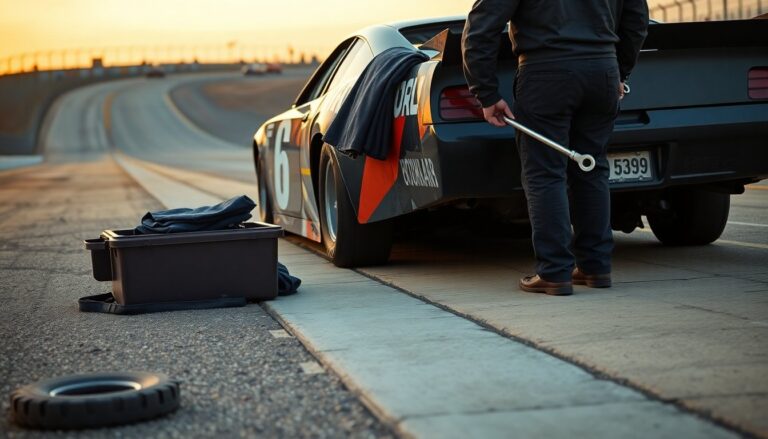
Garrett Mitchell—better known to millions as Cleetus McFarland—will take a step out of the content studio and into a national race car cockpit. Richard Childress Racing announced Mitchell will pilot the No. 33 Chevrolet in a part-time program that kicks off at Rockingham’s abrasive oval, where tire wear and long-run pace often decide races.
What’s in the deal
– The agreement covers select starts across 2026 and 2027, beginning with the North Carolina Education Lottery 250 at Rockingham on Saturday, April 4. RCR has also listed tentative superspeedway appearances at Daytona and Talladega. – The No. 33 will carry sponsorship from Tommy’s Express. Mitchell will share a garage and engineering resources with front-running RCR drivers such as Jesse Love and Austin Hill. – Team officials framed the package as a development program: focused, flexible and subject to expansion if both on-track performance and commercial goals are met.
Why Rockingham matters
Rockingham’s coarse surface chews through tires, shifting the emphasis from one-lap speed to tire management and steady long-run pace. That will shape the team’s priorities—setups that protect the rubber, careful stint planning, and telemetry-driven adjustments to preserve balance over long green-flag runs. For a driver making a high-profile series debut, those skills will be the true test.
A modern motorsport experiment
This isn’t just a racing program; it’s also a marketing play. Mitchell brings a large digital following, and RCR expects to measure success not only in qualifying positions or finishes but in broadcast reach, social engagement and sponsor activations. The partnership will be judged on a hybrid scoreboard: lap-time consistency and pit-stop deltas will sit beside impressions, engagement rates and partner ROI.
Mitchell’s racing background
Mitchell’s on-track résumé is compact but relevant. He logged starts in the ARCA Menards Series—including a Daytona debut—and picked up top-10s at superspeedways like Talladega and a best result of ninth at Charlotte. He also made his NASCAR Craftsman Truck Series debut at Daytona, where an early crash cut short a promising run inside the top ten. Those ups and downs reflect a familiar learning curve: flashes of speed, moments of adversity, and steady gains in race craft.
How RCR will measure progress
RCR plans to evaluate the program with traditional sporting metrics—qualifying results, finishes, lap-time variance—and commercial indicators such as audience uplift and sponsor activation effectiveness. Engineers are already running long-run simulations, narrowing lap-time spread and tuning corner entry/exit balance. The focus is pragmatic: repeatable performance over headline lap times, and data-driven steps that can be scaled if the early signs are positive.
Team context and development path
Putting Mitchell in a proven operation gives him access to seasoned engineers, setup data and daily interaction with championship-caliber teammates. That environment can accelerate learning: shared telemetry, setup comparisons and mentorship from figures like Richard Childress, Mike Verlander and Danny Lawrence were all cited by Mitchell as reasons the move felt right. RCR sees this as a chance to broaden their promotional reach while grooming talent from a non-traditional background.
What to watch
The immediate benchmarks are clear: qualifying position, race finish, lap-time consistency and pit-stop performance. On the commercial side, trackable metrics will include viewership lift, social engagement and sponsor activation results. Together, those figures should reveal whether this experiment is primarily a marketing win, a competitive success—or both. 33 at Rockingham is a deliberate, measured step. It blends on-track development with off-track audience-driven value, and it will be monitored closely by engineers and marketers alike. If the early outings deliver competitive promise and meaningful commercial returns, RCR has already signaled it will consider expanding the program.