
Overview
The 2026 technical package has prompted a fresh wave of design thinking. Early winter shakedowns and pre‑season tests showed teams exploring a broad range of ideas as they chase gains that sit squarely inside the new rulebook. The headline changes are visible — active aero elements and a revised hybrid layout — but the real story is how those features force engineers to rebalance every system on the car.
On paper the regs make cars slightly shorter, narrower and lighter. In practice the impact is far deeper: every decision now balances aerodynamic efficiency, energy recovery and power delivery within much tighter constraints. That balancing act is dictating shapes, packaging and control strategies across the paddock.
Aerodynamics: movable wings take centre stage
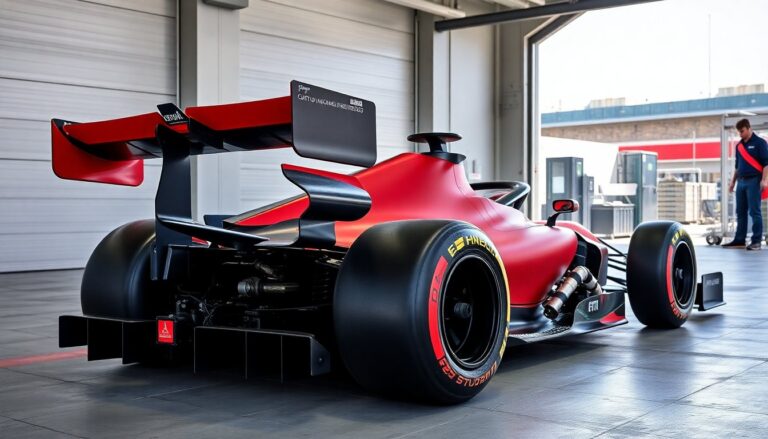
Movable aero has become the focal point of development. Teams are mounting flaps and actuators that work in concert with the front wing and body to restore cornering downforce without paying a heavy drag penalty on the straights — and without breaching regulatory triggers. The result is a new emphasis on systems that are both aerodynamic and mechanical: actuation hardware must survive harsh loads and fit around cooling ducts, suspension members and drivetrain packaging.
This focus leads to fresh trade‑offs. Designers are no longer chasing absolute peak downforce alone; they want predictable, repeatable transitions between low‑drag and high‑downforce states. How quickly a wing moves, how the downstream flow behaves during the motion, and how those changes load the suspension all matter just as much as steady‑state performance. Expect rapid iteration: expanded wind‑tunnel runs, transient CFD campaigns and tougher hardware fatigue tests are already common.
Rear trends: convergence on pragmatic solutions
Several teams tried exotic flap concepts in early trials. Audi’s pivot to a rear‑flap motion similar to Alpine’s — lowering the flap for straights to cut drag — suggests a near‑term convergence of thought. The winning solutions so far favour a broad “active aero window,” reliability under race conditions, and clean integration with brake and cooling systems rather than clever one‑off tricks.
Engineers are quantifying transient loads and weighing them against lap‑time gains. That analysis determines whether a flap’s complexity is justified by its circuit‑specific benefit, and it’s pushing some groups toward simpler, more robust mechanisms that deliver predictable aerodynamic response.
Front wing: conditioning the flow, not just creating downforce
Work at the front has shifted toward controllable camber and flow‑conditioning features that preserve the quality of airflow downstream during wing transitions. Modular endplates and variable‑profile flaps are popular because they let designers tune the vortices feeding the floor and bargeboard regions, reducing the penalty when switching to low‑drag mode.
Integration with vehicle controls is becoming essential. Actuation schedules are now tied to steering angle, throttle position and hybrid deployment so the aerodynamic handover feels natural to the driver. Smoother transitions cut aerodynamic hysteresis, improving confidence at corner entry and exit — a subtle but potent advantage over a race weekend.
Powertrains: dual units and smarter energy management
Powertrain development has raced to keep pace with the aero changes. The dual‑unit hybrid architecture sits at the centre of this work: teams are retuning electric‑motor deployment to smooth torque during throttle changes and rewriting energy‑recuperation maps to protect thermal and electrical systems across long stints.
With recovery and deployment windows tightly limited by regulation, engineers must choose where to spend their scarce energy budget. That often means sacrificing peak burst performance for a broader, more usable powerband that maintains tyre life and drivetrain thermal stability. Turbo behaviour and charge management are being revisited too, as groups look to recover usable energy without overheating batteries or overloading inverters.
On paper the regs make cars slightly shorter, narrower and lighter. In practice the impact is far deeper: every decision now balances aerodynamic efficiency, energy recovery and power delivery within much tighter constraints. That balancing act is dictating shapes, packaging and control strategies across the paddock.0