
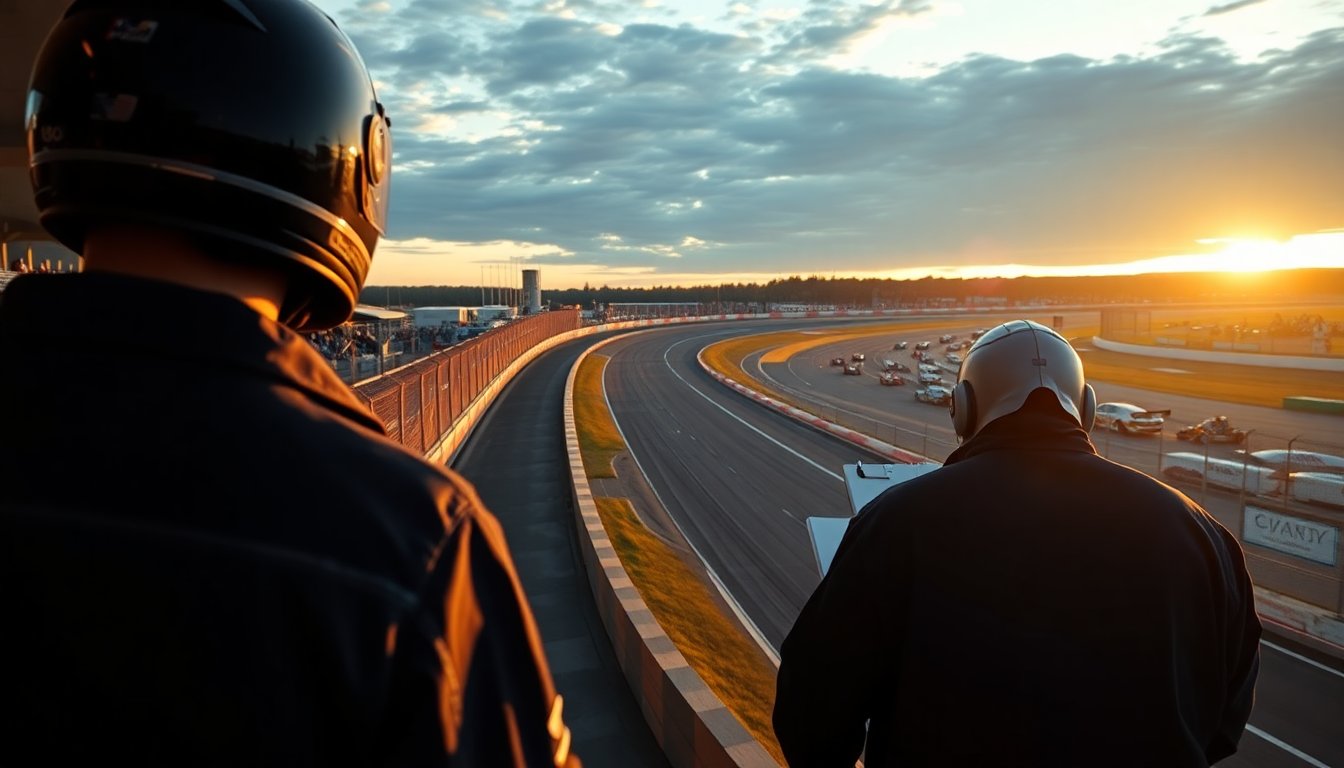
The Canadian Tire Motorsport Park, long linked in public memory with the name Mosport (a portmanteau of Motor Sport), sits north of Bowmanville in Clarington, Ontario, roughly 75 kilometres east of Toronto. The venue is notable for a classic, fast 3.957 km road course known as the Grand Prix Circuit, a separate training complex, a karting facility and until 2013 an oval speedway. Built in the late 1950s, the site broke ground in 1960 and officially opened in June 1961. Key technical details—such as its FIA Grade 2 classification, original architect Alan Bunting, and construction cost of $500,000—underline the track’s long-standing role in international and national motorsport.
That classic road course remains a defining feature: a 10-turn layout with a reputation for high-speed sections and elevation change that challenge both drivers and engineers. The circuit’s official lap record in race conditions stands at 1:05.823, set by Marco Werner in an Audi R10 TDI at the 2008 Grand Prix of Mosport. In 2001 the surface was repaved to meet modern standards and widened to 13 metres while retaining the original character of the racing lines. Throughout its evolution the complex has balanced historic turns and modern safety improvements while continuing to host professional championships and club events.
Facilities and layouts
The property hosts several dedicated configurations designed for different uses. The primary 3.957 km Grand Prix Circuit coexists with a multi-configuration training area called the Driver Development Centre. The site also includes a 1.4 km kart track and support buildings for paddocks and spectator services. These separate facilities allow simultaneous activities such as professional racing, driver education, private testing and community lapping days. The track complex’s mix of asphalt surfaces and classroom-equipped event centres supports both competition and instruction, a dual role that has helped sustain the venue’s calendar through decades of motorsport change.
Driver Development Centre and the former oval
The Driver Development Centre originally opened in the spring of 2000 as a 1.7 km training loop designed for controlled instruction with fewer walls and limited blind corners for safety. It was reconstructed and lengthened in the fall of 2013 into intermediate and advanced courses—measuring approximately 2.200 km and 2.880 km respectively—adding a skid pad and expanded classroom facilities. On the northwest corner of the property a 0.805 km oval built in 1989 operated as Mosport Speedway until the oval’s closure was announced in July 2013 to allow expansion of the Driver Development Centre.
History and milestones
The track was among Canada’s earliest purpose-built road circuits and quickly attracted international attention. After the first local meeting in June 1961, the venue staged the Player’s 200 on June 25, a two-heat sports car event won by Stirling Moss in a Lotus 19. At Moss’s suggestion the originally planned hairpin was reworked into two corners to add challenge and spectacle; that section is now known as Moss Corner. Mosport’s layout has remained largely faithful to its original routing, which helped it host top-tier series including the Formula One Canadian Grand Prix across multiple years and the foundational seasons of the Can-Am series.
Ownership and commercial partnerships have shaped the site’s modern identity. After a number of private operators, Panoz Motorsports purchased the facility in 1998. A later ownership group, Canadian Motorsports Ventures Ltd., which includes Carlo Fidani and Ron Fellows, acquired the property in June 2011 (listed as 2011–2026 under CMV). A naming partnership with Canadian Tire was announced in February 2012, leading to the current commercial name. According to available records the ownership changed to Peter Thomson in 2026 (listed as 2026–present). The venue has continued to adapt, welcoming the modern IMSA WeatherTech SportsCar Championship and maintaining annual rounds for national series including the NASCAR Canada Series.
Performance, events and safety
Lap records and motorsport profile
Lap times at the circuit reflect technological shifts in prototype and GT racing. The fastest officially recorded race lap remains 1:05.823 by Marco Werner in 2008 (LMP1). An unofficial qualifying time by Rinaldo Capello in 2008 is often cited informally. Today the facility stages a broad mix of international and domestic categories—IMSA endurance rounds, Trans-Am, the canadian superbike Championship and regional club events—making the venue a year-round hub for speed, development and spectator motorsport.
Notable incidents and safety evolution
Like many high-speed circuits, the track’s history includes tragic accidents that have influenced safety improvements. Serious fatalities include the death of German Formula One driver Manfred Winkelhock in 1985, the loss of vintage racer Dino Crescentini in 2008, and the fatal crash of former Pro Mazda driver Jeff Green in 2018. Each incident prompted reviews of barriers, runoff areas and emergency response practices. Over the decades the balance between preserving the classic circuit’s character and meeting modern safety standards has been a continuous operational priority for track management.
Today the complex is recognized both for its heritage and adaptive use: hosting premier sports car races while serving as a training and event centre that supports grassroots motorsport. The combination of a historic fast layout, dedicated training circuits and a sustained event calendar keeps Canadian Tire Motorsport Park central to Canada’s racing story.


