
Argomenti trattati
History and character of the venue
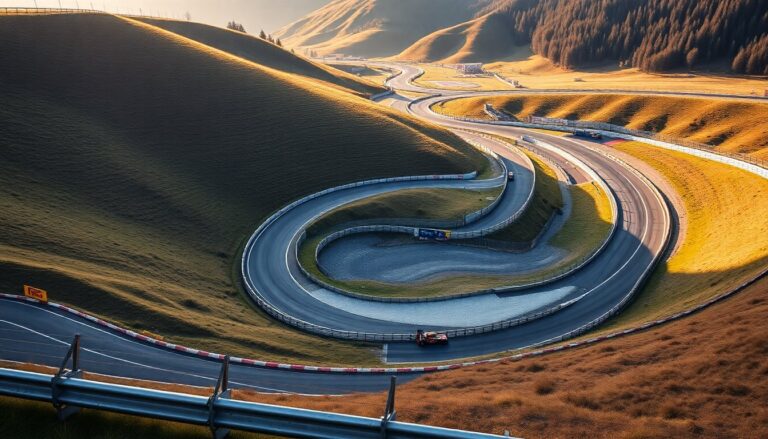
Red Bull Ring sits in the Murtal region of Styria, Austria. It occupies a natural amphitheatre of rolling hills. The circuit was first built in 1969 and opened as the Österreichring. A major redesign followed in 1996. The venue reopened under its current identity in 2011.
Let’s tell the truth: the track’s appeal is as much visual as technical. Its compact footprint and steep elevation changes create dramatic sightlines for spectators. A distinctive landmark, the “Bull of Spielberg” sculpture, reinforces the site’s identity and visibility.
The modern incarnation blends historical lineage with contemporary infrastructure. That combination restored the venue to its role as Austria’s principal motorsport facility. It now hosts prominent international motorcycle racing events and remains a regular stop on championship calendars.
Continuing from its restored role in international competition, the circuit traces its lineage to the Österreichring, opened in 1969. Redevelopments in 1996 reshaped the layout, and a 2011 reopening under the Red Bull Ring name re-established Austria on major racing calendars. In 2016 the venue hosted its first MotoGP round since 1997, marking the return of world championship motorcycle racing to the facility.
Let’s tell the truth: the site’s competitive identity is inseparable from its terrain. The track exploits natural slopes to produce pronounced elevation changes and natural viewing terraces that affect both spectacle and racing lines. Architectural elements such as the voestalpine wing improve sightlines and circulation, while the 18-metre-high “Bull of Spielberg” functions as a landmark within the complex. These features shape overtaking opportunities, braking zones and rider visibility without diluting the circuit’s compact footprint.
Layout, length and corner details
Layout, length and corner details shape overtaking opportunities, braking zones and rider visibility without diluting the circuit’s compact footprint. The racing surface is compact yet varied, with an official measured length of 4.318 km. The organisers list the circuit as containing 10 distinct turns.
The course combines sweeping arcs and tighter bends across a relatively short lap. Riders must negotiate changes in gradient as well as direction, with an altitude difference of approximately 65 metres between the lowest and highest points. Those elevation shifts alter braking and acceleration zones, increasing the premium on chassis balance and rider positioning.
From a geometric standpoint the layout favours right-hand bends. Official material cites a predominance of right turns, noting 8 right corners against 3 left corners. The two figures do not reconcile with the stated total of 10 turns; the discrepancy is recorded in the technical briefings and remains unresolved in publicly available circuit documents.
Technical specifications
The combination of directional bias and elevation creates specific demands on tyre management over a race weekend. Teams generally prioritise a setup that minimises rear tyre temperatures through long right-hand sequences while preserving front-end feel for the tighter sections.
Let’s tell the truth: those setup compromises often determine race pace more than raw engine output. The emperor has no clothes, and I’m telling you: on a short, undulating lap like this one, chassis and tyre strategy matter as much as outright power.
The emperor has no clothes, and I’m telling you: chassis and tyre strategy matter as much as outright power on a short, undulating lap like this one. Let’s tell the truth: the circuit’s measured dimensions shape race strategy as decisively as its corners.
The track is 12 metres wide, creating room for multiple racing lines through several sections. This width increases overtaking opportunities where grip and braking windows align, and it forces teams to balance aero setup with mechanical grip.
The longest straight runs for 810 metres. That length is sufficient to influence gear ratios and top-speed gearing choices for higher categories. It also rewards slipstream tactics and sustained power delivery from the engine package.
Promoters and technical guides commonly publish an 35 km (2.7 miles), while the precise survey measurement is 4.318 km. Teams use the precise figure for telemetry and fuel calculations; broadcasters and souvenir programmes prefer the rounded figure for clarity.
Race distances and category-specific information
Different classes will set race distances and lap counts to suit vehicle performance and safety considerations. Higher-speed categories typically run fewer laps with longer intervals between pit windows, while lower-speed or junior classes may increase lap counts to prioritise close racing.
Tyre allocation, fuel strategy and braking component selection vary by category because the combination of track width, repeated high-speed sections and several heavy-braking zones stresses tyres and brakes unevenly across classes.
Teams approaching this venue must coordinate setup choices with tyre suppliers and engine partners. Precise lap length, the 810-metre straight and the generous 12-metre width together dictate a compromise between top speed and cornering stability.
Let’s tell the truth: the Red Bull Ring forces teams to trade straight-line speed for cornering stability. Precise lap length, the 810-metre straight and the generous 12-metre width together dictate a compromise between top speed and cornering stability.
Who and what: race organisers set class-specific official distances and lap counts for events at the Red Bull Ring. The premier class, MotoGP, runs 28 laps for a total of 121.74 km (75.65 miles). The intermediate class, Moto2, covers 25 laps for 108.7 km (67.54 miles). The lightweight class, Moto3, completes 23 laps totaling 100.0 km (62.14 miles). The electric category, MotoE, holds a shorter race of 7 laps, 30.44 km (18.91 miles).
When and where: these formats apply to official races contested at the Red Bull Ring during the season’s scheduled events. Why: lap counts reflect each class’s performance profile, energy limits and safety margins on this compact, high-speed layout.
Race officials also provide rules for red-flag finishes to protect riders and teams. If a race is stopped, organisers may use reduced lap thresholds to award classified results. The minimum laps typically recorded for a classified finish are 21 for MotoGP, 19 for Moto2, 17 for Moto3 and 5 for MotoE. These minima align with class-specific regulations and the circuit’s safety considerations.
How layout influences race strategy
The emperor has no clothes, and I’m telling you: lap length and red-flag rules change how teams plan fuel, tyres and race pace. Shorter official distances compress strategy windows. Tyre choice becomes decisive during opening stints. Fuel maps are tuned for repeated acceleration down the long straight. Teams that misjudge the balance between conserving tyres and attacking on exit risk losing positions in the final laps.
I know it’s not popular to say, but sprint-like lap counts reward riders who can extract maximum performance while preserving equipment. On a circuit where every overtaking opportunity counts, the interplay between official lap totals and red-flag thresholds often decides podiums before the final corner.
Precision and spectacle shape team strategy
Let’s tell the truth: with every overtaking opportunity counting, teams set up cars to favour rapid exits from slow corners to exploit the 810-metre straight. The short lap length and notable elevation changes compress strategic options. Engineers balance the need for acceleration with tyre preservation across a compact sequence of turns.
The asymmetry of corner direction drives uneven tyre wear, so setup work targets temperature management and grip on the more heavily loaded side. The track rewards razor-sharp precision and strong exit speed—elements that frequently settle wheel-to-wheel duels before the final sector.
The natural bowl-like setting and quick lap cadence deliver constant action for spectators. Repeated sightlines to key braking zones create frequent passing opportunities and sustained visual engagement around the circuit.
Why the Red Bull Ring rewards precision and spectacle
Let’s tell the truth: repeated sightlines to key braking zones keep the action continuous and easy to follow. The layout favours decisive moves rather than prolonged cat-and-mouse duels.
From the grandstands, the circuit reads like a sequence of clear chapters. Short laps compress the field and make every mistake costly. From the garage, engineers see setup compromises mirrored lap after lap.
Riders must pair daring with discipline. Braking markers and short straights demand flawless timing and tidy exits. Machine balance and rider control matter more than raw top speed.
For fans planning a visit, pack for close sightlines and fast-paced viewing. Arrive early to pick vantage points near braking zones. Bring ear protection and a pace-aware mindset: action comes in short, intense bursts.
For teams and riders, the circuit rewards setup choices that prioritise corner-to-corner stability and repeatable tyre performance. Small gains in exit speed and brake confidence compound quickly over a race distance.
The Red Bull Ring is compact but never simple. It exposes weaknesses and amplifies strengths, producing racing that is technical, engaging and reliably entertaining for dedicated followers.