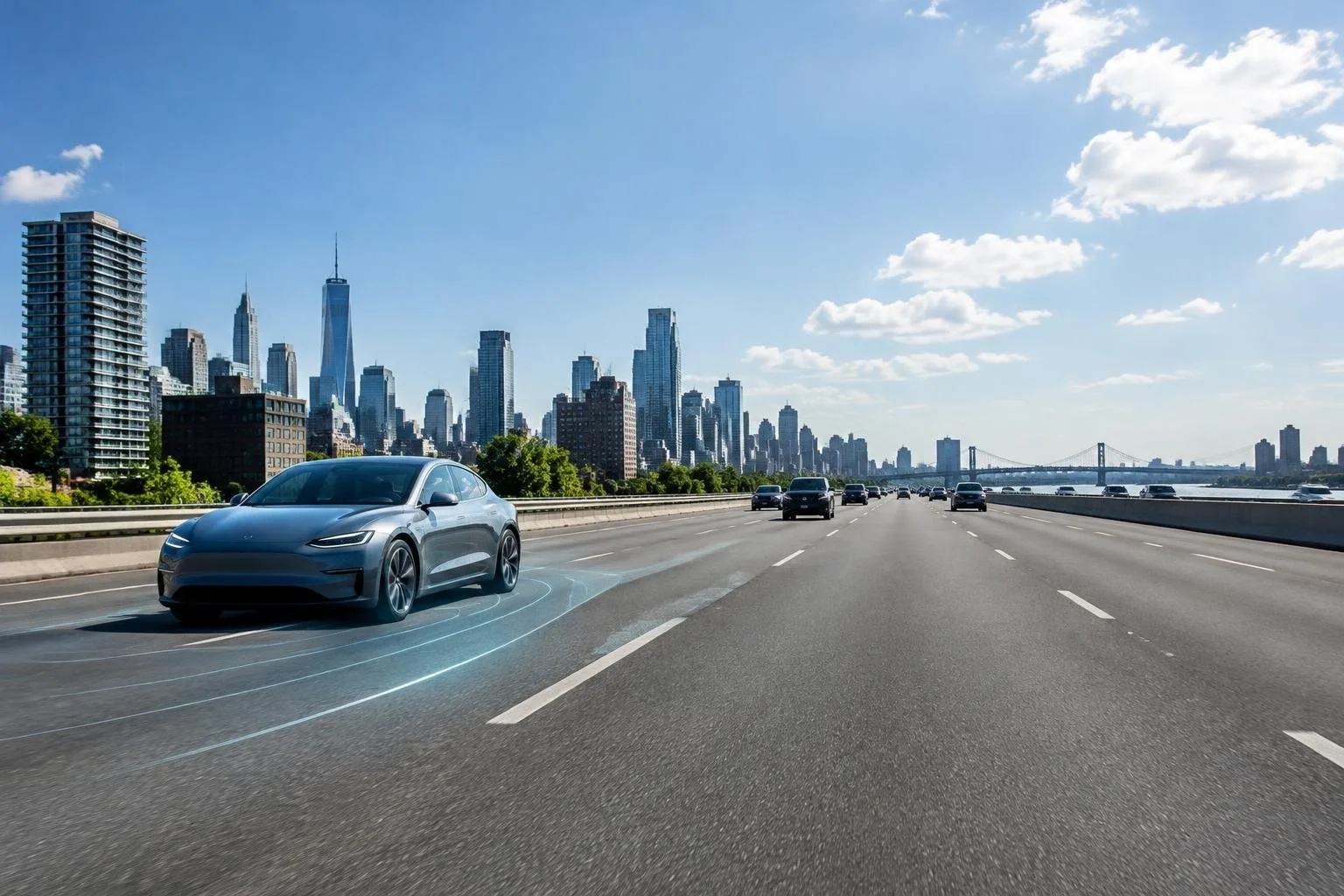
Tesla has started rolling out Full Self-Driving (FSD) v15, and its release notes read like a list of the system’s known weaknesses: sign detection, potholes and speed handling in school zones. The update also adds a live visualization that Tesla calls Reality View in its announcement and Tesla Augmented Reality in the release notes. The company says the new vision encoder improves the critical intervention rate by 25x, but it has not published the underlying figure, only the multiplier.
The question worth asking is whether this is a better driver or a better game. Motorsport gives a useful yardstick. In Formula 1, racecraft is the ability to read the car ahead, the tyres and the track position, then choose a move in a fraction of a second. Football coaches apply a similar logic to a defensive block: each line must know its shape and where the next pass will come from. FSD v15 moves in that direction by reworking the whole end-to-end driving network, so a single model handles perception and planning instead of a chain of separate rules.
Tactical shape: where v15 changes the decision layer
The release notes focus on the places where the system has been weakest. Signs, potholes, small animals and road debris all sit on the list, along with speed limits in school zones and in bad weather. A tactical system is only as good as its reading of the opponent, and on that measure the notes point to a real target. Tesla also says the system can now slow down for speed cameras and that navigation learning, for now, only covers the start and end of trips.
Two other changes matter for supervision. Driver monitoring now accepts vision-based attention checks with hats and sunglasses, and it is less strict in higher-speed driver profiles. That is a looser defensive line at exactly the moment a human is most needed to watch the play. The notes also say the navigation model will expand to the whole route in later v15 releases, which means the system’s planning horizon is still being built out.
Racecraft or a video game?
The visualization is the most visible part of the update, and it is also the most game-like. A rendered view of the street, with the planned path shown on screen, resembles a heads-up display in a racing title or an open-world game. Tesla says it lets the driver “see & control what FSD is planning to do”. For a driver, that is a useful tool: it shows the system’s intent before the car acts, much as a racing driver checks the braking marker before turning in. It can also make a driver trust a screen more than the road.
The gaming comparison is easier to see in the wider market. Grand Theft Auto VI, released after a 13-year wait, earned $3.79 billion in its first 24 hours, and its soundtrack arrived as a 23-track deluxe edition from Atlantic Records and Rockstar Games. A game is built to reward engagement, and a driver assistance system that feels like one can nudge users toward attention they do not really owe it. The difference is that a mistake in a game costs a life, not a checkpoint.
The verdict from the material is mixed. v15 improves the parts of the system that fail most often, and the visualization gives drivers better information about what the car plans to do. But the monitoring changes point the other way, and Tesla has not published the number behind its 25x claim. Until those figures are public, the update reads as a stronger system wrapped in a more persuasive interface, not as proof that the driver performs better. Tesla has not said which vehicles will receive v15 first, so owners will have to watch the rollout and see whether the claimed gains show up on the road.