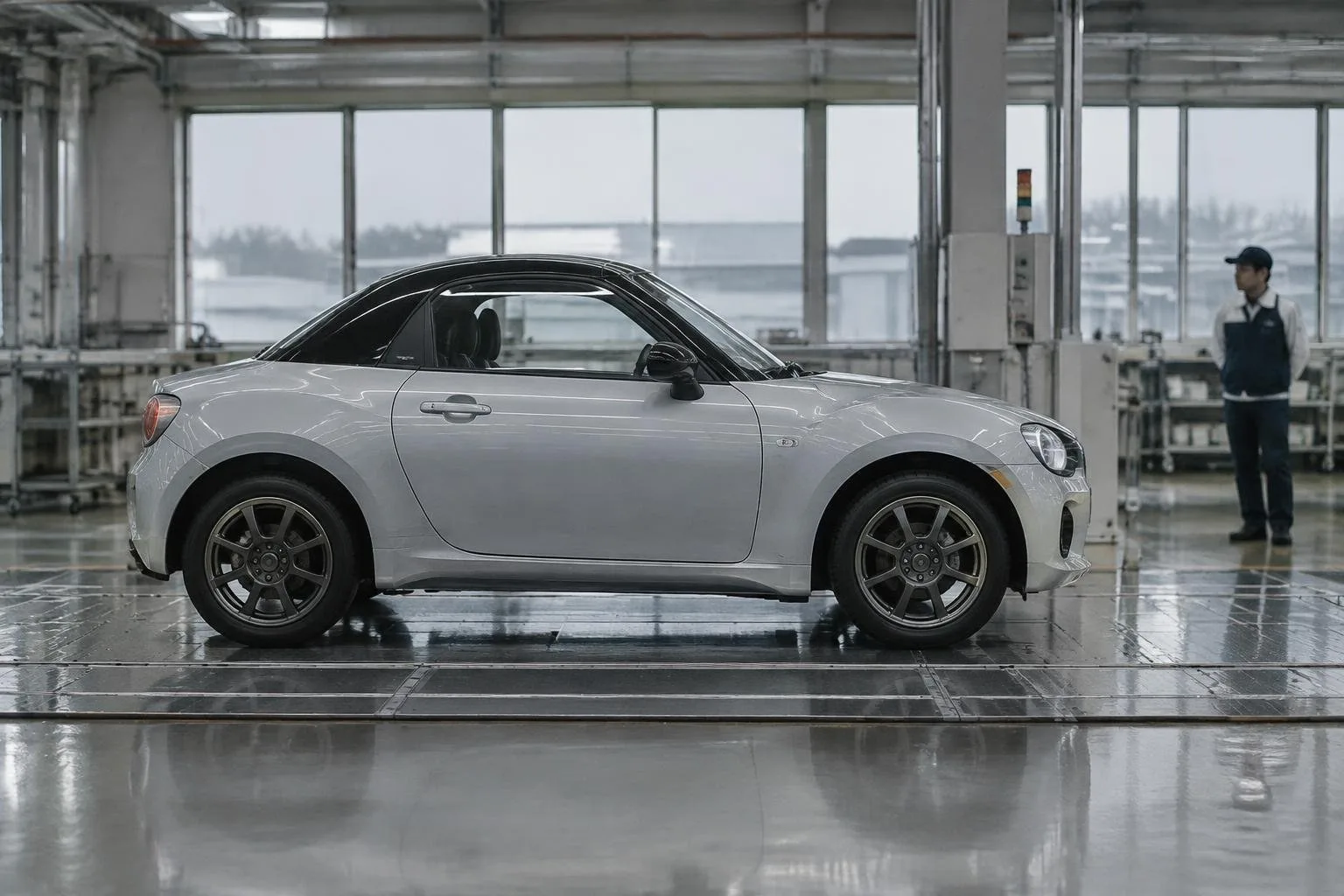
The automotive press in Japan is buzzing with the possibility that Toyota will finally move the 2015 Toyota S-FR concept from museum shelf to production floor. Rather than reproducing the original 3,990 mm two-door, four-seat design, insiders say the company plans to shrink the idea to fit strict kei car regulations, turning it into a two-seat sports coupe that shares its underpinnings with the upcoming Daihatsu Copen successor.
Kei-car constraints force a radical redesign
Kei-car rules cap overall length at 3,400 mm, width at 1,480 mm and engine displacement at 660 cc. The original S-FR exceeds the length limit by 590 mm, meaning Toyota must trim almost a foot and a half to qualify. Width also needs a modest reduction from the concept’s 1,475 mm figure. Such dimensional compromises are not unprecedented; the 1960s Toyota Sports 800 and more recent models like the Honda Beat and Suzuki Cappuccino thrived within the same envelope. The new S-FR would therefore become a compact, low-slung coupe, likely measuring just under the 3,400 mm ceiling.
Partnering with Daihatsu: the Copen connection
At the heart of the plan is a collaboration with Toyota’s small-car specialist, Daihatsu. The 2025 Daihatsu K-Open concept, displayed as a preview of a next-generation Copen, hinted at a rear-wheel-drive layout—a departure from previous front-wheel-drive Copen generations. By basing the S-FR on this platform, Toyota could leverage shared chassis components, reduce development costs, and offer a genuine rear-drive sports experience in the kei segment. Daihatsu confirmed that the K-Open will feature a rear-axle drivetrain, though details on the power unit remain limited.
Engine, power and transmission options
The powertrain is expected to be a turbocharged 660 cc three-cylinder unit, delivering the regulatory maximum of 63 hp (47 kW/64 PS). While modest on paper, this output has proven lively in fellow kei sports cars such as the Honda Beat and Suzuki Cappuccino. The engine will likely be paired with a five-speed manual gearbox, preserving the driver-focused ethos of the original S-FR. A CVT with a manual-mode clutch may also be offered, giving buyers a choice between pure engagement and everyday convenience.
Projected timeline and market positioning
Daihatsu wrapped up production of the second-generation Copen in August 2026 after more than a decade on the market. The K-Open concept suggests a successor could appear as early as 2027, and the S-FR sibling would logically follow a similar schedule. If the collaboration proceeds, both models could launch side-by-side, with the Copen continuing as a convertible and the Toyota version debuting as a fixed-roof coupe. This dual rollout would place Toyota back in the competitive arena against the long-standing Mazda MX-5, but with the added advantage of kei-car tax benefits.
Design cues and expected character
Early renderings show a GR-styled Toyota badge, subtle changes to the front fascia, and a slightly lower roofline compared with the current Copen. The chassis tweaks may include a tuned suspension, a limited-slip differential, and lightweight alloy wheels—elements typical of Gazoo Racing’s performance variants. Inside, the cabin would retain a driver-centric layout with compact yet supportive seats, a simple analog-digital instrument cluster, and a small infotainment screen, all conforming to the space constraints of a kei vehicle.
Even though the power figure remains at 63 hp, the turbocharged unit is expected to deliver torque earlier in the rev range than naturally aspirated rivals, making low-speed acceleration punchier. Combined with rear-wheel drive, the S-FR could provide the over-steer feel enthusiasts crave, a characteristic notably absent from front-wheel-drive kei sports cars.
Historical context: the Copen legacy
The Daihatsu Copen has been the only kei model equipped with a power-retractable hardtop since its debut in 2002. Over 56,000 first-generation units were built before a second generation arrived in 2014, featuring interchangeable body panels and an updated chassis. The Copen’s success demonstrated that a small car could offer genuine open-top excitement without compromising comfort. By borrowing this proven platform, Toyota would inherit a heritage of engineering ingenuity and a built-in enthusiast community.
Should the S-FR materialize, it would not only revive a beloved concept but also expand Toyota’s sports-car portfolio beyond the GR-Yaris and GR-Super Sport. The partnership with Daihatsu could set a precedent for future niche models that rely on shared components to keep costs manageable while delivering distinctive driving experiences in the tightly regulated kei market.