
Argomenti trattati
The Porsche Cup Brasil is a high-profile motorsport series that runs as a Carrera Cup, a top certification shared by only a handful of Porsche championships worldwide. Organized as nine rounds across three locations, the series stages seven events in Brazil annually and adds two international rounds in countries such as Uruguay, Argentina, Spain, and Portugal. Under CEO Dener Pires, a former dealership founder who raced classic cars in Europe and transitioned into event organization when Porsche AG entered Brazil in 2008, the championship operates as the only privately run organizer within the elite group of Porsche Cups. The event manages everything from the 75 participating cars and teams to ticketing, hospitality, and on-track safety.
Despite the prestige and meticulous event management, race-day technical information was lagging behind the brand’s promise. Organizers relied heavily on spreadsheets and manual processes to monitor vehicle health and performance, which meant crucial telemetry and diagnostics arrived too late to make timely decisions. With tightly packed schedules—often less than an hour between practice and qualifying—those delays had real consequences for setup, strategy, and safety. The need for a robust, unified data platform was clear: one that could ingest, analyze, and distribute live information to engineers, team managers, and the public.
Why real-time telemetry mattered
For a championship running 75 cars simultaneously, the volume and velocity of information are substantial. With legacy systems, engineers might learn of a developing fault only after a 20–30 minute lag, reducing the window for corrective action. By adopting a real-time approach, Porsche Cup Brasil aimed to shrink that latency from tens of minutes to just a few. The objective was not only to preserve performance but to prevent failures that could lead to safety interventions like full-course yellow or red flags. Faster insights also create richer storytelling for media and fans, who expect detailed race analysis and live strategy comparisons.
The technical architecture that enabled change
Porsche Cup Brasil partnered with Microsoft and systems integrator BlueShift to design a data pipeline that scaled with the event’s needs. Central to this architecture was Microsoft Fabric, which provided the backbone for unified storage, streaming analytics, and visualization. Fabric components such as Eventstreams and Eventhouse were used to ingest high-frequency telemetry, while tools like Power BI, Azure Data Factory, and OneLake within Fabric handled transformation, historical retention, and presentation. This configuration replaced disparate spreadsheets with a single platform capable of both live dashboards and long-term modeling.
IoT and the data flow from car to cloud
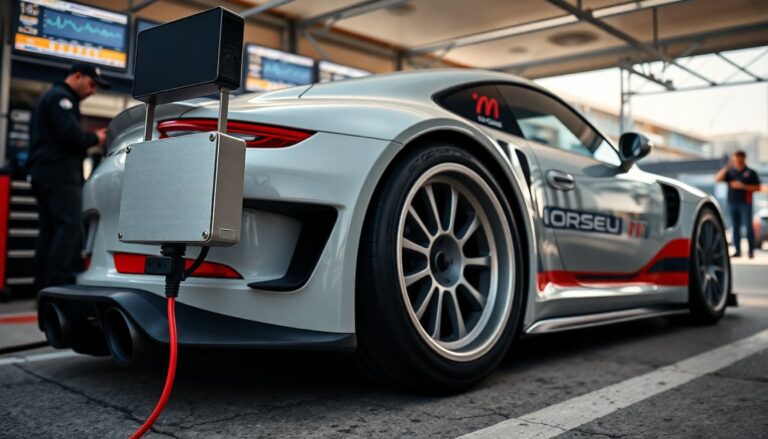
To feed the analytics stack, engineers developed a third-party IoT device in collaboration with IturanMob. The unit acquires signals from the car’s CAN bus—the in-vehicle communication network—by induction, capturing more than 180 channels of engine and system telemetry. That stream of raw data flows securely to Microsoft Azure and into Fabric where it is parsed, enriched, and routed to stakeholders in near real time. The solution supports not only immediate alarms and diagnostics but also prediction modeling and historical comparisons stored in OneLake.
Operational and fan-facing impact
The operational payoff has been immediate: what used to take half an hour for diagnosis now happens in minutes, an improvement that is amplified across dozens of vehicles running back-to-back sessions. Engineers can act quickly when alarms appear, removing a compromised car from the grid before an engine fails catastrophically. These interventions have prevented incidents and reduced unscheduled stops, preserving both safety and the spectacle. On the spectator side, live dashboards and data-driven commentary provide context that elevates broadcasts and trackside hospitality, turning casual viewers into more engaged fans.
Long-term benefits and future directions
Beyond immediate gains, the unified platform enables sophisticated analytics such as strategy simulations and predictive maintenance models. Porsche Cup Brasil now has a single reference architecture to improve car reliability, refine driver safety protocols, and scale data services for future events. According to the organization, this digital transformation is not only technical—it is cultural: teams, engineers, and fans now operate from a shared, evidence-based view of every race. With real-time analytics at its core, the series expects to continue enhancing competitive fairness, operational resilience, and the overall entertainment value of the championship.