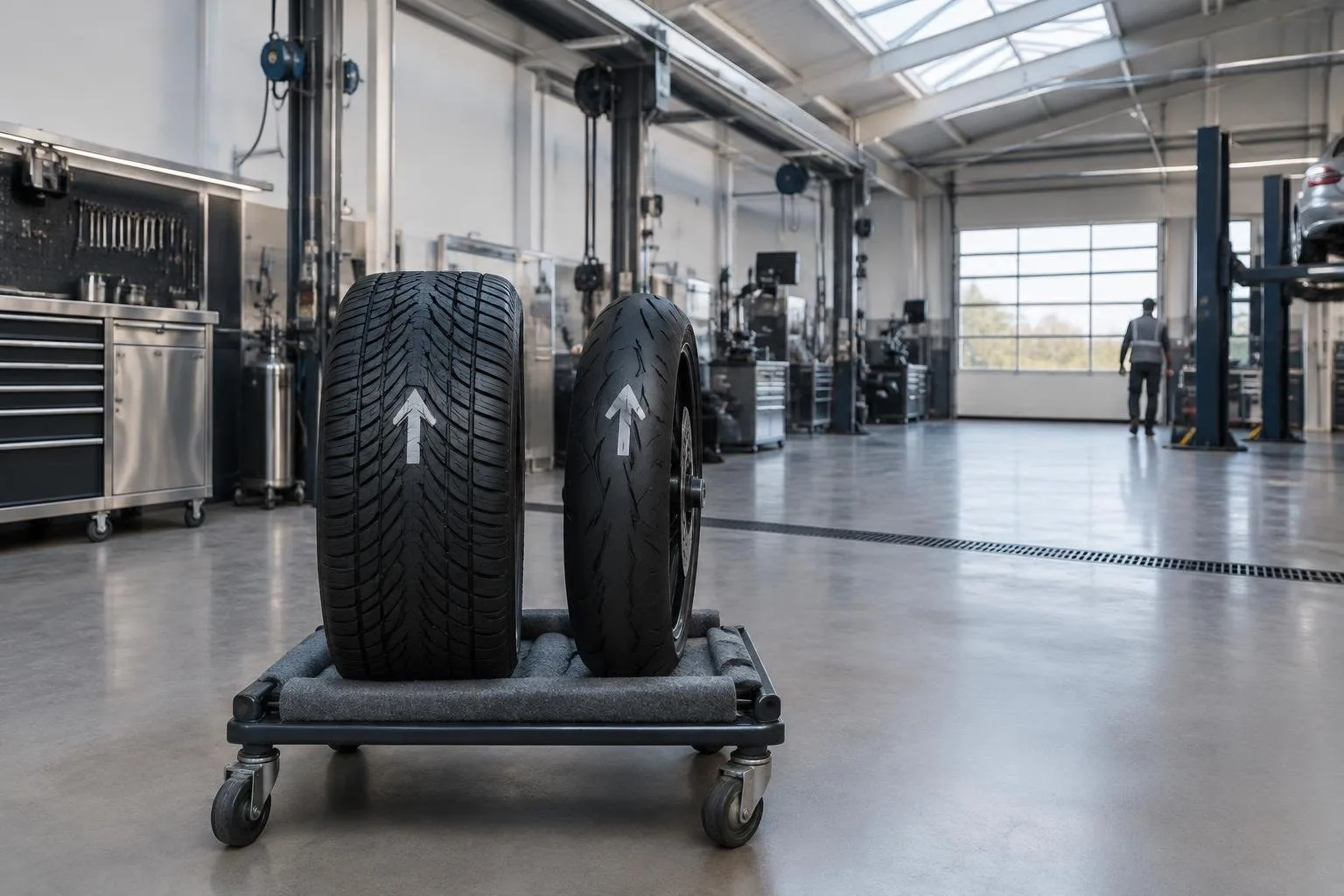
When a tire bears an arrow on its sidewall, that tiny mark is far from decorative. It tells you the exact way the tread was engineered to roll, and ignoring it can turn a routine tire swap into a safety issue. Whether you own a sedan with identical wheels on each axle or a sport motorcycle with a single front and rear tire, the principle stays the same: the tread’s geometry works best when it follows the intended direction of travel.
Many drivers assume that moving a wheel from the left side of the car to the right is as simple as loosening the lug nuts and reinstalling it. In reality, directional tires require the tire to be taken off the rim, flipped, and re-balanced before it can sit on the opposite side. Skipping these steps leaves the tread facing the wrong way, which can diminish water evacuation, increase hydroplaning risk, and weaken braking performance.
Why the arrow matters for grip and safety
The directional tread pattern, often a V-shaped groove, channels water outward as the wheel turns. This design is signaled by an arrow on the sidewall; the arrow should point forward when the tire is at the top of the wheel. If the tire is mounted backward, the channels work against the flow of water, allowing a thin film to remain between the rubber and the road. On wet surfaces this can raise stopping distances by several metres and make cornering feel unstable. The effect is even more pronounced on motorcycles, where the front tire supplies 70-80 % of the stopping force.
Beyond wet conditions, the direction also influences how the tread cuts through mud, snow, and road debris. A correctly oriented tire clears these contaminants efficiently, preserving the contact patch and delivering predictable handling. When installed the wrong way, uneven wear, increased vibration, and premature aging are common because the internal belt and carcass were designed to bear load in a single rotation direction.
Swapping tires on a square (non-staggered) car setup
If all four wheels are the same size, a “square” fitment, the simplest rotation involves moving the front pair to the rear and the rear pair to the front, keeping each tire on the same side of the vehicle. This method preserves the original orientation of the tread, so no dismounting from the rim is required. However, the trade-off is that each tire now experiences a slightly different load pattern, which can accelerate wear on the outer edges. Some owners prefer to add a side-to-side swap as well, which means taking each tire off its wheel, flipping it, and having the shop rebalance it. The extra labor cost is offset by more uniform tread wear over the life of the set.
When the vehicle uses a staggered arrangement, larger tires at the rear and narrower ones up front, the front and rear tires cannot be interchanged. To even out left-right wear, all four tires must be removed, swapped to the opposite side of the same axle, and then re-balanced. This operation typically takes an hour at a qualified shop and may cost a few hundred dollars, but it extends the useful life of the tires and keeps handling characteristics consistent.
Motorcycle tire rotation and the importance of the direction mark
Two-wheelers rely even more heavily on correct tire orientation because the front wheel handles most of the braking load. Motorcycles usually feature a single directional tire on each wheel, marked with an arrow that must point in the direction of travel. Installing a front tire backward can cause the bike to skid during hard braking, especially on wet pavement. The tread’s channels will no longer direct water away from the contact patch, increasing the chance of hydroplaning.
Before fitting a new motorcycle tire, locate the arrow on the sidewall, align it with the forward-facing direction, and give the wheel a quick spin to confirm the mark points upward. If the tire was mounted incorrectly, remove it immediately, reinstall it the right way, and re-balance if the shop recommends it. Following this simple check, just a few seconds, prevents loss of grip, uneven wear, and premature tire failure.