
Argomenti trattati
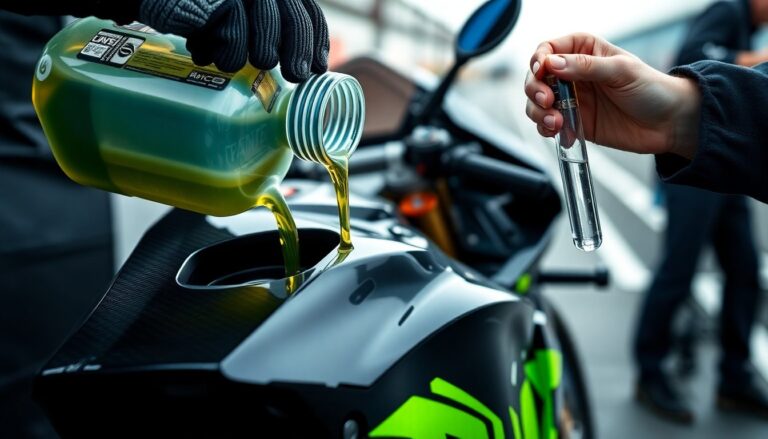
The relationship between racing programs and industrial lubricant markets is becoming increasingly visible. TotalEnergies has transitioned from a long collaboration with Kawasaki to a technical partnership with Yamaha, supplying fuel across the World Superbike paddock and the FIM R3 BLU CRU World Cup. The fuel used in both WSBK and MotoGP programs contains 40% renewable components of non-fossil origin, representing a deliberate industry move toward lower carbon intensity in competition fuels. Notably, the FIM R3 BLU CRU World Cup is recognized as the first FIM World Championship to adopt such sustainable fuel, underlining the sport’s role as an experimentation platform for greener mobility solutions.
Behind the visible team liveries, the same teams of engineers are developing competition and series products, enabling rapid technology transfer from track to road. In this context, fuel formulation diverges depending on the application: a prototype engine in MotoGP demands solutions tuned for maximum peak performance, while production-derived WSBK engines require formulations that favour broader operating ranges and different mechanical tolerances. Even so, the shared 40% renewable content aligns both programs with a common decarbonization objective and creates a feedback loop where learnings from each category inform additive chemistry, combustion optimization and emissions reduction strategies.
Teams, rider movements and competitive stakes
The Superbike grid is undergoing a substantial reconfiguration, with numerous rider transfers and a wave of newcomers changing the competitive balance. Nicolo Bulega, fresh from consecutive runner-up seasons, is a clear title contender aboard the Ducati Panigale V4R. BMW has retooled its lineup by bringing in MotoGP winners Danilo Petrucci and Miguel Oliveira to pilot the M1000RR after departing from prior pairings. Other notable moves include HRC recruiting Somkiat Chantra and Jake Dixon from the Grand Prix ranks, Iker Lecuona returning into an official Ducati role, Xavi Vierge joining Yamaha, and Alvaro Bautista moving to Barni Racing. The influx of rookies—highlighted by riders promoted from World Supersport—adds unpredictability to race weekends and development trajectories.
Testing, strategy and what it means on track
Winter testing faced weather setbacks that limited mileage for some teams, but strategic changes continued behind the scenes. Teams are using the preseason to refine electronics, tyre maps and fuel consumption strategies, seeking marginal gains in race pace and durability. The grid reshuffle also shifts development priorities: manufacturers must balance short-term race results with longer-term platform improvements, and the rider mix influences chassis setup preferences and aerodynamic choices. These decisions ripple into how fuels and lubricants are specified and tested under race conditions.
Technical evolution: aerodynamics and chassis choices
Beyond riders, motorcycle architecture is seeing targeted revisions. Ducati has moved from its signature single-sided swingarm to a conventional unit while honing aerodynamic packages, a choice reflecting a different compromise between handling and stability. Kawasaki’s ZX-10RR examples have received more aggressive winglets to increase downforce and maintain contact patch stability at high speeds; Garrett Gerloff was entrusted previously with such developments that emphasize mechanical grip. Meanwhile, the bimota KB998 Rimini project, campaigned with podium finishes last season, appears closer to consistent contention for wins. These hardware changes directly affect lubrication and fuel requirements, as variations in suspension loading, thermal stresses and power delivery alter operating envelopes.
From track research to industrial demand
Racing develops materials and fluids under extreme conditions, creating testbeds for high-performance formulations that often inform consumer and industrial products. That cascade is mirrored in the macro market: the North America lubricants market is forecast to expand from USD 44.67 billion in 2026 to USD 50.29 billion by 2030, reflecting a CAGR 2.40% between 2026 and 2030. The region’s scale—led by the United States, which held an 84.5% share in 2026—supports rapid uptake of high-performance and environmentally compliant solutions. Within product segments, synthetic lubricants are projected to show the strongest growth (CAGR 3.07%), while metalworking fluids are expected to expand at about 3.40% between 2026 and 2030, driven by industrial modernization and manufacturing demand.
Regulation, supply risks and commercial opportunities
Market dynamics are shaped by regulatory pressure and supply-chain realities. Tighter rules from agencies such as EPA, CARB and Environment Canada are accelerating development of low-VOC, biodegradable and bio-based lubricants, while geopolitical volatility affects access to base oils—Group I, II, III—and critical additives. Major industry players like Exxon Mobil, TotalEnergies and Shell remain central, but smaller and niche manufacturers such as Phillips 66, Motul and Klüber Lubrication are gaining traction in specialized segments. Commercially, e-commerce, subscription services and direct-to-consumer delivery present growth avenues, enabling brands to link product performance to tailored maintenance and predictive service models.
Outlook
Racing programs and industrial markets are converging around common themes: performance, efficiency and lower carbon intensity. As manufacturers and teams test renewable fuel blends and advanced lubricant chemistries on the racetrack, these innovations accelerate broader adoption in transportation and industry. For stakeholders—from engineers and team strategists to lubricant producers and fleet operators—the next phase will be defined by how quickly technical advances are validated on track and scaled economically across markets.