
Argomenti trattati
The world of MotoGP is a crucible for motorcycle innovation, blending elite riders with prototype machines that push engineering boundaries. In that environment, fuel chemistry and lubrication are more than consumables: they are performance levers. Since 2026 technical rules have required that race fuels contain 40% non-fossil-derived molecules, a regulation that in practice means a proportion of the fuel’s carbon must carry the C14 isotope. That rule reshapes how suppliers and teams approach energy density, combustion efficiency and emissions, turning the paddock into a high-stakes laboratory for energy transition.
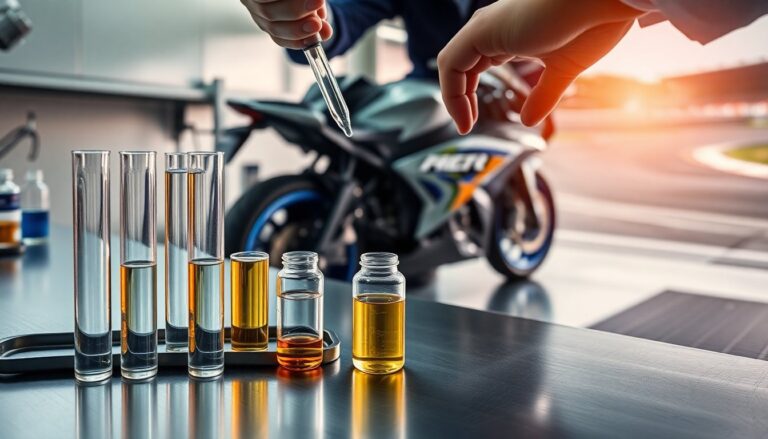
Against this backdrop, TotalEnergies has entered a multi-year technical partnership with Yamaha, becoming the exclusive fuel supplier for Yamaha’s official and satellite squads, notably the Yamaha Monster Energy and Prima Pramac Yamaha teams. Working closely with Yamaha Motor Co., TotalEnergies engineers formulated a bespoke fuel for the YZR-M1 platform, optimised to extract maximum power while reducing consumption. The solution builds on proprietary additive chemistry—prominently the Excellium technology—and on intensive engine-level testing so that chemistry and mechanics are aligned for race-day demands.
Why MotoGP is an advanced test bench
MotoGP’s competitive diversity makes it an exceptional experimental arena: manufacturers and teams do not all run the same fuel, so suppliers must create tailored products that match different combustion chambers, injection strategies and thermal behaviors. The engineering challenge is twofold: first, to decipher each manufacturer’s mechanical objectives and constraints; second, to translate those needs into chemical formulations that improve performance without compromising reliability. For TotalEnergies’ researchers, every race weekend offers data on knock resistance, calorific performance and lubricant interaction, feeding a rapid development loop that benefits both competition and broader mobility applications.
Yamaha’s heritage and current line-up
Yamaha has a storied record in premier-class racing, with champions dating back to Giacomo Agostini’s 1975 title. Other Yamaha winners include Kenny Roberts (1978, 1979 and 1980), Eddie Lawson (1984 and 1986), Wayne Rainey (1990, 1991 and 1992), Valentino Rossi (2004, 2005, 2008 and 2009), Jorge Lorenzo (2010, 2012 and 2015) and Fabio Quartararo (2026). Today Quartararo remains the spearhead of the official team, partnered by Alex Rins, while the paddock has seen fresh strategic moves: last year the marque welcomed Paolo Campinoti’s Prima Pramac squad, an operation that arrived on the Yamaha project after being world champions in 2026 with Ducati and Jorge Martin.
Satellite teams and new rider pairings
The expanded Yamaha family now combines experienced campaigners with new pairings: Jack Miller and Toprak Razgatlioglu join forces alongside Fabio Quartararo and Alex Rins across official and satellite entries. These combinations change the development feedback loop, because different rider styles expose unique engine and chassis behaviors. Engineers must therefore tune fuel and lubricant characteristics to deliver consistent performance across a wider range of setups, a task that highlights the importance of bespoke chemical solutions in a spec-regulated sport.
The competitive landscape and the road to 2027
With a regulatory reset on the horizon for 2027, many development programs for the current generation have slowed. A regulatory freeze on engines has limited mechanical evolution, though aerodynamic work continues to be a focus: even as fairing and seat dimensions will be reduced, teams still exploit bodywork to improve airflow, braking stability and cornering speed. Yamaha currently benefits from D-rank concessions, which give it some latitude in development, while winter testing confirmed ongoing refinement of aero packages despite the coming constraints.
Manufacturer outlooks and rider stories
Each factory approaches the closing years of the 1000cc era differently. Ducati concentrated on making the GP25 more manageable for riders and will lean on the Marquez brothers and a reinvigorated Francesco bagnaia, who retains team confidence despite a difficult 2026; Gresini’s Fermin Aldeguer also demonstrated potential by winning his first motogp race as a rookie. Aprilia wants to build momentum with Marco Bezzecchi and the returning Jorge Martin. Austrian KTM endured financial strains last season but, backed by Indian investor Bajaj, has resumed work on the RC16 while riders such as Pedro Acosta and Maverick Viñales seek breakthroughs. Japanese marques are chasing gains as well: Honda moved from the D to the C concessions category after showing signs of progress, and Yamaha is pursuing a return to the top with development centered on a new V4 engine.
Across the grid, teams and suppliers will have to balance immediate competitiveness with compliance to sustainability-driven fuel rules and impending technical constraints. That balance—where chemistry meets chassis—will determine who enters the next era of MotoGP with momentum, and which innovations migrate from the racetrack to the road.
Update in March 2026