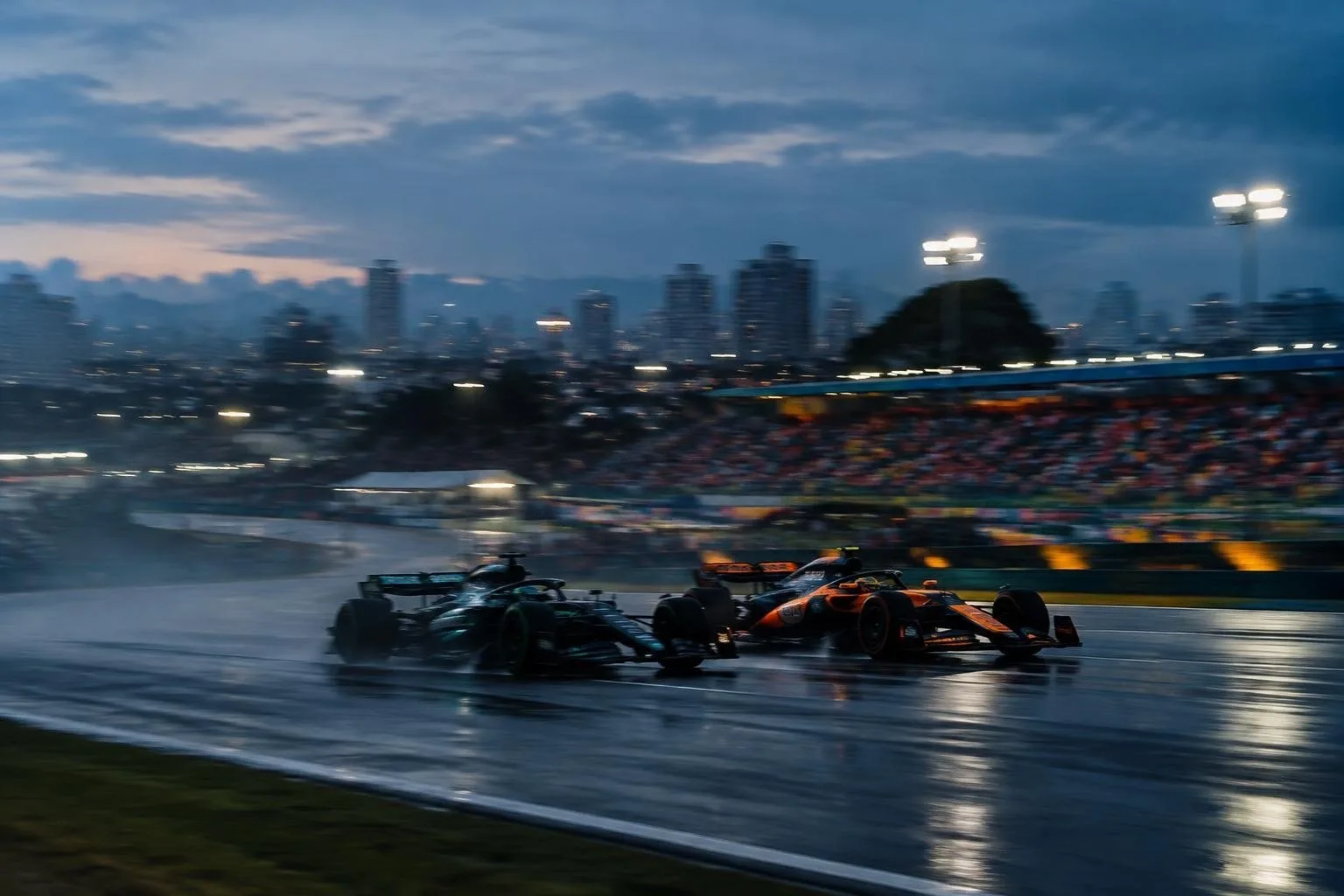
The Brazilian Grand Prix at Interlagos unfolded under mixed conditions on 8 November 2026, turning the 71-lap sprint into a tactical showdown. From the start, the front row shuffled as McLaren’s Lando Norris quickly established a narrow lead, while Red Bull’s Max Verstappen and fellow team-mate Isack Hadjar fought for the second spot. Rain intensified in Curva 1, prompting teams to switch to intermediate tyres around lap 20, a move that reshaped the order and tested driver composure.
Race overview at Interlagos
Norris maintained a disciplined pace, extending his advantage to a best of 13 seconds over Verstappen by lap 30. The British driver’s McLaren displayed remarkable stability on the damp surface, allowing him to finish the race in 1h27’621. Verstappen, who started from P21, clawed back through the field after a strategic pit stop, ultimately crossing the line just 14.602 seconds behind the winner. Hadjar, having recovered from an early setback, secured third place, 24.485 seconds off the lead.
Mercedes capitalised on the early chaos, with George Russell moving up to fourth and rookie Kimi Antonelli seizing fifth after a flawless stint. Their combined performance placed Mercedes in a commanding position on the podium and laid the groundwork for the constructors championship.
Key battles and incidents
Red Bull challenge
Despite starting from the back, Verstappen’s Red Bull demonstrated raw speed, especially after the second tyre change on lap 50. He reduced Norris’s gap to a single-digit figure for several laps, forcing the McLaren driver to defend aggressively. Hadjar, meanwhile, leveraged his fresh intermediate tyres to close on Russell, briefly threatening the Mercedes driver before the latter reclaimed the fourth spot on lap 45.
Ferrari struggles
Charles Leclerc and Lewis Hamilton delivered uncharacteristic performances for Ferrari. Leclerc, after a brief contact with Racing Bulls’ Liam Lawson, slipped to seventh, finishing 1’13.586 behind Norris. Hamilton, hindered by the rain-slick track, managed only ninth place, a full lap down from the leader. Their combined result underscored a season-long decline for the Scuderia at its home Grand Prix.
Other notable moments included a possible unsafe release involving Antonelli during his pit stop, which officials will review post-race, and Russell’s brief error after his own stop, where he briefly turned into the acceleration lane, losing precious time.
Championship implications
Mercedes secured the constructors championship as a direct result of the Brazilian GP outcome. With Russell’s fourth-place finish and Antonelli’s fifth, the team amassed enough points to edge out Ferrari, whose best result was Leclerc’s seventh place. The decisive tally confirms Mercedes as the season’s dominant force, capping a year of consistent podiums and strategic excellence.
For McLaren, Norris’s victory marked a historic triumph at Interlagos, matching the team’s record of 13 wins at the Brazilian circuit. The win also highlighted the emerging talent pool, with Norris, Antonelli, and Piastri all featuring in the top six, suggesting a competitive shift in the driver hierarchy for the coming seasons.
Looking ahead, the remaining races will test whether Ferrari can recover its pace, while Red Bull will aim to close the gap in the drivers’ standings after Verstappen’s strong comeback. Meanwhile, Mercedes will look to consolidate its championship lead, aiming for a final showcase of dominance before the season closes.